March 25 to March 31 is the thirteenth week of 2024. This week, we remain in the Solar Term of Spring Equinox (Mar 20- Apr 3) and enter the micro-seasons of “First Cherry Blossoms” (Mar 26-Mar 30).
Basho, Issa, Buson, Soin, and Reichhold wrote the poems selected for this week.
The 24 Solar Terms
The 24 solar terms were created by farmers in ancient China (206 BCE and 24 CE) to help guide their agricultural activities. Each solar term is 15 days long and is based on the climate around Xi’an, the capital of China during the Han Dynasty (206 BCE to 220 CE). (1)
Spring Equinox
Spring Equinox is the fourth Solar Term of the year and the fourth Solar Term of Spring. Chunfen (春分) is the Chinese name for this season. Chunfen (春分) means “the day time and night time are almost the same.” Chunfen (春分) also falls between the Solar Term of Beginning of Spring and Beginning of Summer.
Flying Kites
In ancient China, people would write their personal concerns and medical issues on paper kites and fly them during Spring Equinox. The kites would lift into the air and then the string would be cut. The kite would then float away in the breeze taking away those concerns.
In contemporary times, kite flying has become a traditional activity for kids and adults. People still write blessings and prayers on the kites and fly them high in the sky for the gods to see.(3)
The 72 Seasons
The 72-season calendar was established in 1685 by Japanese astronomer Shibukawa Shunkai. Each season lasts for about 5 days and offers “a poetic journey through the Japanese year in which the land awakens and blooms with life and activity before returning to slumber.”(4)
This week we have the micro-seasons of “First Cherry Blossoms” (Mar 26-Mar 30).
The Cherry Blossom
The cherry tree, similar to the peach tree, is a member of the Prunus genus of the Rosaceae family. The ornamental cherry tree is the one that produces the most stunning cherry blossoms.
Hanami or “Flower Viewing”
There is a Japanese tradition called hanami, which means “flower viewing”. Hanami originated with plum blossoms during the Nara period (710-794 AD), and was primarily undertaken by the members of the Royal Court.(6)
Now, hanami is something that everyone participates in and it revolves around the cherry blossom. To celebrate, people gather underneath the cherry trees for picnics and parties.
To help people locate the best cherry blooms, the Japan Meteorological Corporation publishes a cherry blossom forecast map. This map estimates the beginning and peak bloom times across Japan.
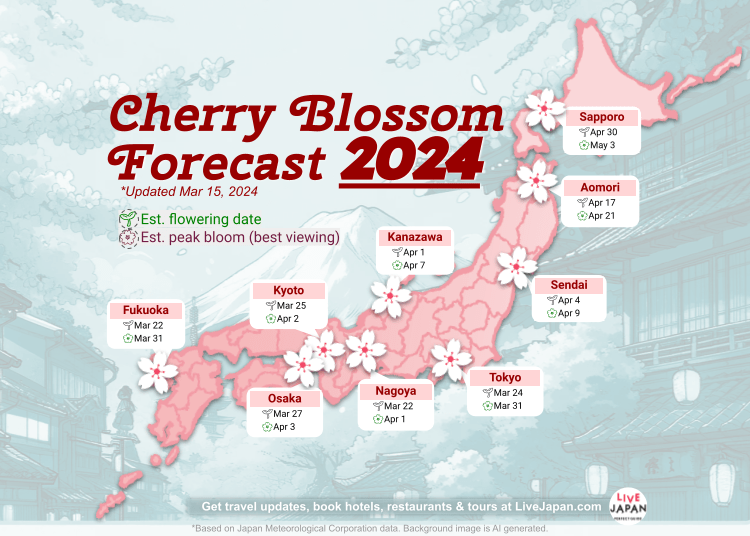
Astronomical Season
March 31, the last day of week thirteen, is 12 days past the spring equinox and 81 days until the summer solstice (June 20, 2024).
March’s Full Moon
March’s full moon arrives on March 25. This full moon is sometimes referred to as The Worm Moon.
Catherine Boeckmann at The Farmer’s Almanac says the following about the Worm Moon.
“For many years, we thought this name referred to the earthworms that appear as the soil warms in spring. . . .However, more research revealed another explanation. In the 1760s, Captain Jonathan Carver visited the Naudowessie (Dakota) and other Native American tribes and wrote that the name Worm Moon refers to a different sort of “worm”—beetle larvae—which begin to emerge from the thawing bark of trees and other winter hideouts at this time.”
Other traditional names for March’s full moon include:
- Sugar Moon from the Ojibwe
- Wind Strong Moon from the Pueblo
- Goose Moon from the Cree
In the Christian tradition, March’s full moon may be called the Lenten Moon or the Paschal Moon. The name of the moon depends on its relation to the spring equinox. This year, March’s full moon occurs after the spring equinox and is known as the Paschal Moon. If the full moon occurred before the spring equinox it would be called the Lenten Moon.
For more information about the Worm Moon, read Boekmann’s full article here.
Haiku and Kigo
The kigo, or season word, is one of the key parts of the haiku. The Yuki Teikei Haiku Society provides us with the following explanation for why we use kigo in haiku.
“A kigo is a poetic device used in haiku to denote a season; it’s a powerful word or phrase that can conjure up many allusions, historical references, spiritual meanings, and/or cultural traditions. Its use in haiku, a poem of few words, is especially effective because of this power to expand its meaning beyond the literal and to create a larger aura of seasonal mood, historical/ literary context, and/or cultural implications.”(9)
Visit The Haiku Foundation’s “New To Haiku: What is a Kigo?” for more information
This Week’s Kigo
In The Five Hundred Essential Japanese Season Words selected by Kenkichi Yamamoto, “cherry blossoms”, and “first cherry blossoms’ are relevant kigo.
In Jane Reichhold’s A Dictionary of Haiku, “cherry blossoms”, “cherry budding”, and “cherry petals” are all relevant kigo.
Cherry blossoms are often seen as a metaphor for the impermanence of life and can be associated with the Shinto concept of mono-no-aware. In an article titled, “Mono no Aware: The Transience of Life” from The Berkley Center for Religion, Peace, and World Affairs explains the connection this way.
“Mono-no-aware is a challenging perspective to put into words successfully; it can be literally translated to “the ahhness of things” or to “the bittersweet poignancy of things.” What comes most easily to mind is the beauty of the cherry blossom; the flower blooms intensely, yet only for a short period of time each year. As the flowers die and the petals fall, cherry blossoms line the streets like a layer of soft, pink snow, and are most beautiful when captured between the precipice of life and death. That is precisely the unique appeal of the cherry blossoms; their aesthetic focuses on the unavoidable transience of the material world that exists.”
The Center concludes the article by stating:
“It boils down to this: appreciate the moment, because the beauty experienced in it will never be the same. It will pass. It will end. And that is okay because as life changes, new beauty, perhaps of a different kind, will arrive. Every season the cherry blossoms die. But every year, they come back to, once again, coat the streets in their ethereal and incomparable demise.”
Here is the link to the full article if you want to read more.
Now with all this in mind, let’s read some haiku.
Basho
a hangover
is nothing as long as
there are cherry blossoms
(tranlsated by Jane Reichhold)
The spring night
has come to an end,
with dawn on the cherry blossoms
(translated by R.H.Blyth)
How many, many things
They bring to mind--
Cherry blossoms!
(translated by Robert Aitken)
Issa
cherry blossoms--
under every tree
a Buddha on display
(translated by David G. Lanoue)
the war lord
forced off his horse...
cherry blossoms
(translated by David G. Lanoue)
without regret
they fall and scatter...
cherry blossoms
(translated by David G. Lanoue)
Buson
The departing spring
hesitates
late cherry blossoms
(translated by Allan Persinger)
Instead of cherry blossoms
peach blossoms would fit
this little house
(translated by Allan Persinger)
Nishiyama Soin
No, no, not even the cherry blooms,
can equal the moon tonight.
(translated by Asataro Miyamori)
Reichhold
a long journey
some cherry petals
begin to fall
cherry blossoms
a truck goes by advertising
"Wonder Bread"
Haiku invitation
This week’s haiku invitation is to write a haiku or senryu referencing cherry blossoms.
Share your haiku in the comments below, or post on your page and link back. I can’t wait to read what you write!
You can support this newsletter work by donating at “Buy Me a Coffee” or shopping at our bookstore.

Thank You!
About the Haiku
Basho’s haiku were retrieved from “Matsuo Bashō’s haiku poems in romanized Japanese with English translations” Editor: Gábor Terebess. Issa’s haiku were retrieved from David G. Lanoue’s Haiku Guy. Buson’s haiku was retrieved from Foxfire: the Selected Poems of Yosa Buson, a Translation by Allan Persinger. Nishiyama Soin haiku was retrieved from The Classic Tradition of Haiku: An Anthology. By Faubion Bowers. Jane Reichhold’s haiku were retrieved from Dictionary of Haiku.
- “The 24 Solar Terms”; China Educational Tours
- “6 Solar Terms of Spring”; China Educational Tours
- “24 Solar Terms: Things you may not know about the Spring Equinox”; ChinaDaily
- 72 Seasons App
- “Japan’s 72 Microseasons”; Nippon.com
- “Japanese Cherry Blossom Festivals”: JRPass.com
- Boeckmann, Catherine; “Worm Moon: Full Moon in March 2024”. Almanac.org
- “Mono no Aware: The Transience of Life”; The Berkley Center for Religion, Peace, and World Affairs
 SeasonWords.com
Beautiful! I love when the flowering trees in my neighborhood come to bloom. It’s a welcome sight of spring’s arrival. Also, I’m lucky to live near Washington, DC, with a lot of cherry blossoms at the Tidal Basin.
Next week, I’m going to post some of my old photos of trips to see the trees. And in 2012, I wrote a haiku to celebrate 100 years of Japan’s gift of cherry blossom to Washington, DC:
Japan’s gift of trees
one hundred years gratitude
blooms and tourists rise
Dave that’s a wonderful tribute!
Thank you Ashley! 🙂
Hi Dave, I will keep an eye out for your photographs. What a great haiku to honor that celebration.
Thanks for sharing.
I just posted the cherry blossom photos today: https://davewilliamswriter.wordpress.com/2024/04/05/gift-of-cherry-blossoms/
Glorious!
They are gorgeous!
Dave,
Love the haiku and the story behind it. It was a wonderful gift that is celebrated every year, and yet…I have never made it to D.C. during that time. Some day, perhaps. In the meantime, I hope to see your photos. ~Nan
A very lovely poem in its honor, Dave.
Thank you Nan 🙂 I posted photos of the DC cherry blossoms today: https://davewilliamswriter.wordpress.com/2024/04/05/gift-of-cherry-blossoms/
Nice! Thanks for sharing the link.
Thank you Dave. Your beautiful poem is a lovely thank you to their gift that keeps on giving each year.
Thank you Suzette 🙂
I missed the cherry blossoms (mostly imported trees) here this year as we’ve had so much rain. However, a few days ago the Blackthorn (Prunus spinosa) flowered. A native cherry tree flowering before producing leaves.
First blossoms;
Flowers before leaves,
Blackthorn.
I have heard of Blackthorn but we do not have them in the southern U.S.–to hot I imagine. So, I read up on them and wish I could see some and perhaps try some of various kinds of liqueur made from sloe! Peace, LaMon
Thanks, LaMon. I’ve tasted gin infused with sloes but I understand that in some parts of Spain the sloes are used in a liqueur.
The Wikipedia article I read also mentioned liqueurs in Greece and France. And actually, I haven’t had a liqueur in many years–though I will add a little rum to my coffee sometime 🙂
Even when the day doesn’t bring what we expected the unexpected may delight.
Griffin, what a great philosophy! I have to write this quote down.
Thank you 😊
Great introspective words Griffin! Thank you.
Hi Ashley, I like that you were able to add in some information about the Blackthorn, and then LaMon added another layer with the liqueur research. That is one of the things I enjoy about haiku, it can give us an opportunity to learn new things! Thanks for sharing this piece.
Wonderful haiku there, Ashley. Having learned about blackthorn trees from you, I appreciate your haiku even more.
We have several flowering trees in our yard. The first is a crab-apple tree that gets its leaves (and they are starting to come out now) and then its pink blossoms. The next is a service-berry tree, and its delicate white blossoms come first and the leaves second. The neighbor’s apple tree follows the crab-apple’s pattern so that we have about a month or so of flowering trees. All are as beautiful as your blackthorn tree. ~Nan
A very lovely haiku, Ashley. I didn’t know anything about it so I just looked it up. It’s so interesting. :)
I’m not familiar with the Blackthorn variety, so I’ll have to Google it. Also, a lovely haiku 🙂
Mark,
Always a pleasure to learn new concepts. I wrote my verses here;
<a href=” https://julesinflashyfiction.wordpress.com/2024/03/29/fact-and-fantasy-1p-xxiv-nd-3-29/ “><strong>Fact and Fantasy </strong></a>
Hi Jules, I always enjoy where you go with these prompts! What an adventure.
🙂
I really think they all are delightful, but the second I like because of the use of mono-no-aware, JP.
🙂
Oooh, what a great group, Jules. I particularly adored blossoms fall and the dragon sentence at the end.
These are so beautiful Jules. My favorite is “…memory of pink blossoms dance…”
We can imagine dragonflies as real dragons… 🙂
Good morning, everyone. And thanks again for a great post! Basho’s hangover haiku is my favorite of the lot. Here is my haiku response:
beauty too brief
cherry blossoms fall–
Good Friday
Peace to you all,
LaMon
Hi LaMon, This is great! I like the cultural/religious connection that you make with this one. I can imagine if we brought this haiku up in our haiku club we could talk for an hour about the layers of meaning.
LaMon,
What a beautiful and peaceful haiku. I love it!
Peace,
Nan
Wow, LaMon, incredible juxtaposition here.
Yes, so many layers, LaMon. A lovely haiku on Good Friday.
aww. Ahh. How beautiful. Adore this thanks
You have woven rich connections to faith and nature’s beauty all in one. Marvelous piece, LaMon!
Thank you Suzette!
Peace,
LaMon
Where are the flowers?
They are only in Japan.
It is so cold here.
Hi Adele, Yes! While some get to celebrate the arrival of cherry blossoms, others still have snow!
Yes, Mark. I guess we have to be patient….
Adele,
Lovely, thoughtful haiku. We haven’t been blessed with cherry blossoms yet, but do have daffodils blooming (and alas, the crocuses are gone for the year). ~Nan
Thank you, Nan.
Where are you?
We are still waiting for the warm weather.
Adele,
I am in northern Ohio. With the closeness of Lake Erie, we often have late spring snows. Hopefully, we won’t have that happen this year. ~Nan
I am not far from the other side of Lake Erie. We had snow last week.
I am sorry Adele that you are going through all this cold..it doesn’t take away though, from the fact that this is a beautiful poem.
Thank you!
Hope it will warm up soon!
Me too!
🙂
Adele, We’re a block from Lake Erie. What part of Ontario are you located? ~Nan
We just moved from the Niagara Region to the Chatham-Kent region!
I too hope it will warm up soon Adele. We have a bit of snow left from two snowfalls this past week here in Northwestern Canada.
Yes, I agree, Suzette! Where do you live?
Alberts Canada.
Oops sorry, that should say..Alberta Canada
Nice! My son just moved to Calgary.
Awesome! Calgary had some snow two weeks ago. I’m not sure what things are like now.
on back road bridge in Mexican spring heat wave
impoverished local selling colourful hand-painted kites…
I drove on by, soon sad,
tribal ancestors reproaching my selfishness in swirling dust clouds
Oops, I didn’t read the invitation at the bottom to include cherry blossoms. I riffed off the kites mentioned in the main article section! So here goes, spontaneous haiku:
Between heaven and hell
this moment and forever
life is falling cherry blossoms!
Hi Baron, Thanks for two fine poems! The last line of the kite poem is wonderful, and I really like the way you frame up your cherry blossom haiku “between heaven and hell/this moment and forever” that is good.
I love spontaneous haiku, and your haiku work. I call those quickly written haiku, my off the cuff haiku. ~Nan
Baron,
I thought about writing about pairing kites and cherry blossoms, but finally decided against doing do. Glad you did, and I really like the monoku working together as a group. Well done. ~Nan
These are great haiku!
love the haikus..❣️
Hi Cindy, Thanks for stopping by! There are so many great cherry blossom haiku.
It’s my pleasure, Mark❣️
Thanks Mark for great information about the phases of the moon and the gifts associated with cherry blossoms in traditions and culture. Much appreciated. Have a great weekend!
Hi Suzette, Thanks for the comment and have a good weekend!
Hello! Hope everyone is having a good day. Thank-you Mark for this wonderful post. I am going to go back and look over the information and read all the poetry again.
Paschal moon
yellow daffodils
popping up in the garden
~ ~ ~
Even at my ripe old age, I look forward to the tiny eggs wrapped in colorful foil this Sunday.
sugar moon
needing some sort of self-control
chocolate Easter eggs
~ ~ ~
I agree with LaMon–Busha’s hangover poem is great! 🙂
I love “sugar moon”
Thank-you Griffin 🙂
I love ”…the pink snow
cherry blossoms…”
Hi Maddy,
“Sugar Moon” is great! Well done!
Thanks, Mark!
That means a lot to me!
Oh, Madeleine, that sugar moon gets me every time. 😉 Wonderful poem.
Thank-you, Eavonka. That makes my day! 🙂
Maddy… holidays can be fun… I saw your cherry blossoms too.
Very nice.
(oh…your post to my piece was off of Eavonka’s… so I can’t reply there…) ~Thank you!
Yes, they can. :) Thank-you Jules for the compliment. Of course…I understand:) Hope you are having a nice evening.
Lovely! And your second haiku made me smile 🙂 I also need to exercise self-control around chocolate. Sometimes, that is. Because other times, I’m fine about giving into temptation!
Too funny, Dave. :) I have asked my daughters to hide the left overs from me… I forgot this morning that I have to ask now when I want one…provides some interesting conversation. :)
Love your haiku. My kids ate all their Easter candy in a few days.🤦🏻♀️
Thank you Melissa. That’s great. I love that! :)
I’m not sure how much their teeth love it.😬😅
Yeah!:).
can’t hear cardinal
but see the pink snow
cherry blossoms
Wonderful, Griffin! 🙂
Very nice! I like how you pull in a couple of different senses with this one.
I forgot to include my cherry blossom:/ There are many cherry trees lining the streets in our neighborhood. It didn’t look like our tree was going to bloom at all. My daughter noticed a few blossoms the other day.
cherry blossom
waiting
for the pink moon
Hi Maddy, That three for this week! Spring gives us so much to write about.
It does Mark. Lol:) It is! Spring is so inspiring and so is your blog! It is clear that we all learn so much here! :)
I love how you’ve incorporated next month’s full moon into your poem to show how late the cherry blossoms are this year and add extra texture to ‘pink’.
Thanks Eavonka, for the feedback…that means a lot to me.
Madeleine,
I love this ku. I have tried and tried to use Pink Moon, but I’ve never managed to make it work. You did, and marvelously. ~Nan
Dear Nan,
I know you will too, soon 🙂 Looking forward to reading your Pink Moon!
Madeleine,
I wrote this in 2019, but am still not convinced that it could be improved in some way, shape, or form.
crab-apple blossoms peek
through the leaves
pink moon
~Nancy Brady, 2019
Crab-apple blossoms are pink, by the way, and the blossoms come after the leaves are already out. ~Nan
Hi Nan, If you are working with this one, I wonder about the word “peek”. For me, peek has a sharp tone/quality where blossoms and leaves feel softer.
Interesting point, Mark.
I would leave out peek and not replace it.
crab-apple blossoms
through the leaves
pink moon
I agree with Mark, Nan. I think the word peek does have a sharp quality (and might neglect to convey what you want in your haiku). I do love the juxtaposition between crab apple blossoms and pink moon. I read it aloud with out the word “peek” and as Mark suggested it’s much softer and quite lovely,
Mark, Eavonka, and Maddy,
I see what you mean. Maybe that’s what it was missing (or should have been missing). I do like your suggestion of leaving ‘peek’ out. Thank you, all. ~Nan
🙂
Thanks, Mark, for the information about the cherry blossoms, the kite flying, and the names of the full moon for March. In that vein, here are some cherry blossom haiku:
first steps…
catching cherry blossoms
in chubby fist
~Nancy Brady, 2017 Honorary Mention, Polish International Haiku Competition, 2017
cherry blossoms whirl…
young girl freed
of training wheels
~Nancy Brady, 2017 Honorary Mention, Vancouver Cherry Blossom Festival, 2017
a boutonnière of cherry blossoms
pinned to her tux
–spring gala
~Nancy Brady, 2023 Honorary Mention, Vancouver Cherry Blossom Festival, 2023
Paschal Moon
cherry blossoms petals caught
in the Easter bunny’s fur
~Nancy Brady, 2024
#offthecuffhaiku
If you can’t tell, I just chose a few cherry blossom haiku I’ve written. I have quite a few more, but won’t bore everyone with them. I think the first haiku that I had published was a cherry blossom haiku. For the “winning haiku” of the day on an online site, I won a mouse pad with my haiku printed on it. Does anyone even use mouse pads any more?
Wow, Nan, you’ve gotten honorable mentions twice in the Vancouver Cherry Blossom Haiku contest? I can see why! These are all so well crafted.
Eavonka,
Twice I have gotten lucky, or fortunate, in the Vancouver Cherry Blossom Festival. Every once in a while, I write something that clicks. I have to admit I was thrilled. Thanks for the compliment on there. ~Nan
You are extremely talented and absolutely earned those awards, Nan!
Thanks; I just found this hiding in my email.
This is wonderful Nan…my favorite haiku is first steps…it’s precious! Like Eavonka, I see why you received these honorable mentions. Thank you for sharing your wins with us! :)
Thanks, Madeleine. First steps is one of my favorites, too. I entered it in a local contest (well, I couldn’t win, but I could enter). It was roundly dismissed as a bad haiku by a couple English profs because it wasn’t written 5/7/5. Go figure! At least the Polish Haiku Association was a bit more enlightened. 😉
Hi Nan, Thanks for sharing your experience with the local contest. I think that is important for people to hear that sometimes it is not that your haiku is bad, it is that it might not fit the theme or the style of the editor/judge. Good thing to keep in mind when submitting your work to places.
Mark,
I would agree except these poetry professors have not kept up with English Language Haiku enlightened syllable/ sound (or lack of syllables) thought on the subject. In other words, they are not lifelong learners of the craft they claim for themselves (per their degree).
I know that for a long time I wrote only in 5/7/5, twisting the words around to make the syllable count, but once I let go of that restriction my haiku improved (or so I like to think).
Yet, there can be excellent 5/7/5 haiku still and there are some places that still accept only haiku written with a strict syllable count.
I agree with Eavonka. I always, and I know we all do appreciate that you share your experiences with us…they ring loud and clear to never give up! :)
Hi Nan, This is an impressive collection of cherry blossoms! Very well done. When did you win that mouse pad? 2017? I haven’t used a mouse pad, or a mouse, in years.
Mark,
It might have been 2012-13. It was some time ago for sure.
https://www.nbsmithblog.wordpress.com
These are wonderful haiku, and I like how the first three haiku “grow up.” It’s a lucky toddler who catches cherry blossoms blowing around 🙂
Thank you, Dave, for the kind remarks about my cherry blossom haiku.
In hindsight, I’m not sure if I could catch cherry blossoms in my hand, but I’d sure try. As would a toddler. They are not easily stopped by anything, which is why I always reminded parents and grandparents complaining about child-resistant caps that a child might be able to open them because they are trying to figure out how everything works (or doesn’t). Adults, however, give up pretty easily saying they can’t do it. Those caps are designed to take a bit longer (child-resistant NOT childproof) in the hope that an adult would take extra precautions, but ultimately “saving the day” by removing the medication bottle from the hands of a young inquisitive child. Sorry…exiting soapbox mode. ~Nan
Oh to be
in Kyoto right now
cherry blossoms
Thank you so much for the Japanese Sakura map with the best dates for viewing, Mark. Definitely a bucket list item, for sure. Also a good reminder that I need to be checking for the photos that come out of Japan during this season. There is little I find as beautiful as those.
This is such a wonderful poem, Eavonka!
Thanks, Maddy, I just entered it in a contest. 🤞
I am keeping fingers crossed, Eavonka! :)
You will do great!! 🙂
This is such a charming poem, Eavonka… It makes me want to be viewing the cherry blossoms in Japan, right now!
Wouldn’t it be wonderful?
Yes, it would be! :)
Eavonka,
What a classic haiku! Love it! I heard Michael Dylan Welch talk about Kyoto and cherry blossoms, and yours is a fresh take on the subject. Well done.
That makes me feel so good, Nan. I felt the spirit of the Masters in me for a moment. I hope I feel that again!
Hi Eavonka, This is a lovely haiku! This one does a great job of capturing a moment and conveying a feeling without telling the reader what to feel. I like it!
I’m so pleased by your comments, Mark. I can’t ask more from a haiku than that.
I agree with Nan and Mark, Eavonka. When I read your poem for the first time, I felt it had the essence of one of the masters, like Issa, but still uniquely yours 🙂
Oh my goodness, Maddy, there is no bigger compliment! Thank you so much.
Awww! :)
Eavonka,
To be with so many blooms in an ancient place… *sigh*
Wouldn’t it be wonderful, Jules?
I just wanted to share some big news as I am so grateful to the community here for all your support and for all I’ve learned about kigo here.
A tan-renga I wrote with Robert Kingston (English poet) was just accepted for the next issue of Frogpond!
I am over the moon to be finally making my debut. This was my 5th time submitting.
Great news!! I look forward to reading it. I’m sure it will be beautiful.
Peace, LaMon
Thank you, LaMon, it does have images, but it’s also fairly layered. I hope you enjoy it.
Eavonka, That is wonderful! Congratulations. I can’t wait to read this.
You’ve helped me so much to get to this point, Mark. I appreciate it so much!
Congrats, Eavonka! I can’t make that claim, and I doubt I ever will.
~Nan
I’m grateful to Robert for collaborating with me, and I’m sure that helped. It’s hard to keep submitting over and over again. I understand deciding to not do it or even want it.
Eavonka, I have found that hitting my head against the same door over and over only hurts my head.
I’m glad for you and Robert. That’s exciting news and probably the first of many haiku published in Frogpond for you.
~Nan
I have the same feeling with Heron’s Nest to be honest. I’m ready to take a break from trying there. What’s most important is to still enjoy writing and that’s what I hope to do more of the rest of this year!
I’m to that point, Eavonka. Just writing for myself and submitting only if and when I want. I guess that is why Mark’s blog here has become so important to me. I can write haiku, get feedback from fellow poets, and enjoy reading their haiku and senryu. No pressure, just fun!
This is all very exciting, Eavonka! I am so happy for you! Looking very forward to reading it, too!:)
Thank you so much, Maddy! I don’t want to get everyone’s hopes up too much as in a tan-renga one poet does 3 lines and the other ends it with 2 lines. I did the 2 lines.
Still, I’m so excited!
Eavonka, the 2 lines are just as wonderful! 🙂
The two lines cap the tan-renga! They are very important, E. I’d be thrilled to put together a tan-renga having the two-line verse.
We should write some together, Nan!
Thank you, MaddyHaikus!
Hi Mark thanks again for another great inspirational post. Here is my response to this week’s prompt -‘Cherry Blossoms’.
Have a great day everyone.
Hi Goff, what a delightful poem! I hope you are having a great weekend!
Thanks Mark. Hurrah! The sun is out here at last. Happy Easter My Friend.
Hello Mark,
Here is my link:
Have a lovely weekend.
Hi Suzette, Wonderful photo to go along with a great haiku!
Thank you Mark. I like that photo too… so many trees in bloom at once.
how many, many things. Bashō. That one is so beautiful. Again a most lovely post, Mark.
I have a post for you this week. Cannot add photos yet but I will.
have spent Friday and Saturday going to temples with each of my two sons who came to offer support over my recent loss. I’m better now.
here’s my contribution. And happy Easter.
https://selmamartin.com/loveliest-of-trees-the-cherry-now/
I am sorry for your recent loss, Selma. Thank-you for the beautiful poetry and
images. Hope you have a good Easter.
Thanks most dearly Maddy. It’s my best friend since childhood… she’s been called home.
We visit temples to see the blossoms, mostly, and to take pictures at this time of the year. But this year, the trees are bud-heavy. Only few are opening to the sun, really. I think the explosion will be next weekend. But rain is predicted 🤷🏽♀️ Thanks for your lovely comments.
I am very sorry, Selma. Childhood friends are very much like sisters and brothers especially as we get older. She will be in my prayers.
Hi Selma, So sorry for your loss. I am glad to hear that you have family to be with you during this time.
Thanks for linking up and sharing such a wonderful collection of cherry blossom poems.
Thanks for the kind message, Mark. Bless you. Happy Easter.
I am looking forward to reading more of the poems above. It’s my son’s birthday, today (on what I love to ponder this time of year, Holy Saturday)…heading back to his celebration .
Happy birthday to your son. And now Happy Easter too. 🤗
Thank-you, Selma.
Happy Easter and Spring. Hope it warms up for everyone.
🐣 blessings
Right back to you, Selma! :)
https://benjamintonkin.wordpress.com/2024/04/05/5-4-24-haiku/
Thanks for joining the conversation! I hope all is well.
Very well, thank you for the great prompts.
A lovely poem, Ben. 🙂
Thanks, Maddy.
🙂
Mark,
To see my husband’s photo montage of the eclipse, check out my Facebook page under Nancy Brady Smith as I shared his post. ~Nan
PS. Others are free to check there as well.
Thanks for sharing this. I’ll try and find your page over there.
Shared in on Twitter, too, Mark.
I haven’t been on Twitter in months! I wonder what is happening over there?
Mark, Not as much as before, but there are haiku poets who share news of journals asking for submissions, and of course, the usual suspects like Eavonka and me. I have noticed I hadn’t seen you around and missed seeing you there. ~Nan