On June 26th we will enter the micro-season of “The Iris Flowers”. This is the second micro-season of the season called Summer Solstice. The other micro-seasons within Summer Solstice are:
- The Common Self-Heal Dries (June 21 – June 25)
- The Iris Flowers (June 26 -June 30)
- The Crow-dipper Sprouts (July 01 – July 06)
These seasons were established in 1685 by Japanese astronomer Shibukawa Shunkai. While they are specific to Japan, you can use these seasons as a starting point for exploring the world around you.
To celebrate this season, we will learn about the iris and then read haiku by Basho, Issa, Shiki, and Ogawa Shushiki.
The Iris Plant
The iris is a genus of perennial flowering plants that encompasses over 300 different species. Irises are primarily found in northern temperate zones including North America, Europe, and parts of Asia. Depending on the species, the irises have either bulbous or rhizomatous root strategies. Many of the irises that are native to southwestern Europe grow from bulbs. Rhizome irises can be found in a variety of climates and grow best in well-drained soils.(1)
The Iris Flower
Most irises bloom in late spring or early summer. The six-petaled iris flower can come in a variety of colors and is particularly unique because it has three outer petals that hang down and three petals that stand upright. The petals that hang down are called “falls”, and the petals that stand upright are called “standards”.
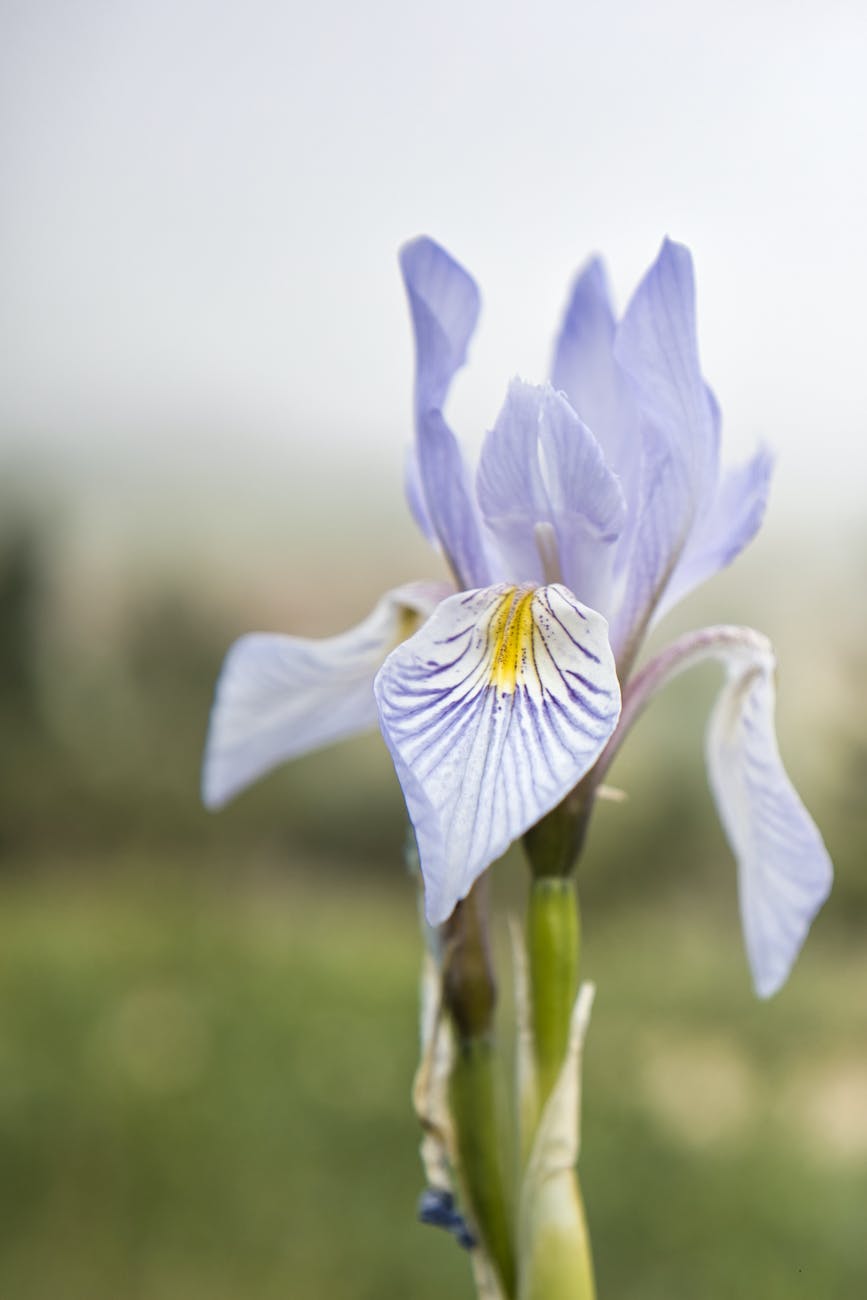
Purple is the most common color for the iris and is associated with wisdom, dignity, and respect. Blue irises are also fairly common and are associated with faith and hope. White irises are associated with purity and compassion, while yellow irises represent friendship and bonding.(4)
Classifying Irises
The irises that you will typically find in a garden are separated into three main groups: Bearded, Beardless, and Aril.
Bearded Irises
These irises are called bearded because they have soft hairs along the center of their falls. Most of the bearded irises are native to central and southern Europe. The American Iris Society further separates the bearded irises into six subcategories: Miniature Dwarf Bearded, Standard Dwarf Bearded, Intermediate Bearded, Border Bearded, Miniature Tall Bearded, and Tall Bearded. These subcategories are primarily used for judging and competitive garden shows.
Some bearded irises are known to be “rebloomers”. This means that they will bloom once in late spring and then again later in the year.(5)
Beardless Irises
Beardless Irises do not have soft hairs on their lower petals (the falls). These irises are mostly native to Asia.
One of the best-known beardless iris is the Japanese iris (Iris ensata), also named the Japanese water iris. The flowers of the Japanese iris are about 3 to 6 inches across and come in a variety of colors. They are bulbous irises and grow well in damp and boggy areas. The Japanese iris is frequently featured in Japanese watercolors.
Aril irises
The American Iris Society has also included a third group of irises called Aril irises. This grouping is made up of iris found in the Oncocyclus and Regelia categories of irises. These iris are native to the deserts and mountains of the Middle East and thrive in hot and dry climates with poor soils. These irises do have beards, but the beard formation is so different from bearded irises that they needed their own category.
Seasonal Haiku
The World Kigo Database list “Iris” (ayame) as a mid-summer kigo. Dr Gabi Greve’s provides this bit of commentary about the Iris in Japan. “There are many more words in Japanese to differentiate between the many kinds of iris that flower mostly during the rainy season, giving a special elegance to an otherwise dreary season.”
In The Five Hundred Essential Japanese Season Words as selected by Kenkichi Yamamoto, “wild iris”, “Japanese iris”, and “blue flag” are listed as related kigo. The season word blue flag refers to “a type of iris, sometimes called ‘rabbit-ear iris’ in North America.” Kenkichi Yamamoto also includes a variety of other flowers as summer kigo including “peony” and “multiflora [rose] blossom”
In A Dictionary of Haiku Jane Reichhold list the all-inclusive term of “flowers” as a summer kigo. She also includes more specific flower types including “lilies” and “morning glories”.
Now, with all these flowers in mind, let’s read some haiku.
Basho
honorable figure
I will bow down to
rabbit-ear iris
(translated by Jane Reichhold)
I’ll bind blue flags
around my feet:
sandal cords
(translated by David Landis Barnhill)
Long conversations
beside blooming irises -
joys of life on the road
(translated by Sam Hamill)
Issa
irises--
where that rainbow
starts from
(translated by David G Lanoue)
geese and ducks
wipe their feet...
on the irises
(translated by David G Lanoue)
Shiki
this lone iris
white
in spring twilight
(translated by Stanford Goldstein and Seishi Shinoda)
Ogawa Shushiki
Even after waking
From the dream
I’ll see the colors of irises
(translated by Alex Kerr)
Commentary from translators. “This was Shushiki’s death poem, meaning that when she awakens from “life’s dream” she will see radiant irises.”(Alex Kerr)
Haiku Invitation
This week’s haiku invitation is to write a haiku or senryu that references a flower that is currently blooming in your area.
Share your haiku in the comments below, or post on your own page and link back to this post. I can’t wait to read what you write!
Resources
- “Iris”; Brittanica
- “Iris”; Wikipedia
- “Irises”; Almanac.com
- “Irises; The Ultimate Guide”; Interflora.com
- “Iris Classification”; The American Iris Society
- Beaulieu, David. “How to Grow and Care for Japanese Iris”. The Spruce
Basho’s haiku was retrieved from Matsuo Bashō’s haiku poems in romanized Japanese with English translations. Issa’s haiku was retrieved from David G. Lanoue’s HaikuGuy.com. Shiki and Ogawa Shushiki haiku retrieved from The Classic Tradition of Haiku edited by Faubio Bowers.

 SeasonWords.com
Reblogged this on Art, Music, Photography, Poetry and Quotations.
Beautiful post! I love this flower truly! I think we are on the same wavelenght! Best wishes Phil
Hi Phil, That’s what I was thinking! I hope you have a good weekend!
Thanks Mark, you also.
Hi Mark,
I really enjoyed your post. Irises are such beautiful elegant flowers. They have always been one of my favourite flowers.
Here is my haiku,
Yellow flag iris
swaying in the mirrored pond
a dragonfly basks
@suewoodpoetry
I have only seen darning needles so far.
Lovely visual.
Thank you so much:)
You inspired me! Love this post, Mark.
Hi Charlotte, Thanks so much for adding your haiku to this week’s discussion, and now I know about another great flowering hibiscus species!
Such a beautiful scene!
Thank you:)
Hi Sue, wonderful haiku for the season! Thanks so much for sharing and adding to the conversation. I hope all is well!
Lovely haiku, Sue.
Thank you 🙂
Beautiful 💞
Thank you 🙂
One of my favourite flowers, if not my most favourite! Though I never thought to bind them on my feet.
Yes! The Basho haiku is interesting. It comes from The Narrow Road to the Deep North translated by David Barnhill.
Here is an excerpt:
“Kaemon sent us off with his sketches of Matsushima, Shiogama, and other sites, and for a farewell gift he gave us two pairs of straw sandals, the thongs dyed dark blue. It was a gift that revealed him to be a man truly devoted to the aesthetic way.
I’ll bind blue flags
around my feet:
sandal cords
ayamegusa / ashi ni musuban / waraji no o”
Thanks Mark for another inspirational and informative post.
Here is my offering to this weeks prompt reference ‘a flower that is currently blooming in your area.
Happy Friday Everyone.
Hi Goff, thanks for joining the conversation and adding such a joyful haiku!
Reblogged this on Word Craft Poetry and commented:
Naturalist Weekly offers a haiku/senryu invitation every Friday. This is a great way to learn more about using a kigo (season words) in your haiku. I enjoy this challenge. Look in the research links to find out more about the forms.
Hi Colleen, Thanks so much for sharing with your audience!
You’re welcome, Mark.
Ha, Mark, this reminds me that I tried growing iris’s for the first time this year. Of the 8 bulbs planted only one flowered! Shiki’s haiku resonates with me! Enjoy the weekend! 🙋♂️
Hi Ashley, We are having the opposite experience here. We are needing to transplant some of outs because they are taking over our little garden. Glad you like the Shiki haiku. I haven’t included a lot of his work lately so it was great to find one that worked for this season.
Hello Mark,
Thank you for your informative post. I like iris. I have been thinking about getting larger iris for my own garden. Like tulips, their life is not long, but they are lovely.
Here are mine for this prompt;
…the iris flowers…
What a story your poems tell, Jules!
While I delve into fantasy, I often write about what I know. ~Thank you.
Jules, Thanks so much for sharing these! I really enjoyed your collection for this week. “When alive” is wonderful!
🙂
🙂
~Thank you.
Perennials are often the most beautiful, short lived flowers. 🙂
So we need to honor their time with us.
Thank you for this information, and for the prompt, here’s my response:
Thanks for sharing your work and joining this week’s discussion! I hope you have a great weekend.
‘Preciate it, thank you, hope you have a good one!
Just read your always insightful blog after returning from Birmingham Botanical Gardens where I spent a wonderful hour this morning. Peace, LaMon
bog garden
common jewelweeds…
eastern towhee calls
Hi LaMon, Thanks so much for sharing! I really like that you were able to draw a haiku out of your morning at the gardens. Wonderful!
I like this haiku, using jewelweeds and towhee. Unique, and inspired.
Lovely, LaMon. Feels very contemplative. Simple joy.
I was inspired to write two poems today. One from my childhood and one a flight of fancy.
summer ritual
picking iris from mom’s
bulb magazine
hopping through
the Japanese meadow
rabbit-ear iris
Hi Eavonka, These are great! “hopping through” is a lot of fun. I am impressed with your ability to find spaces for word play in your haiku. Wonderful!
Thank you, Mark! Wordplay and sounds bring me the most join when I write haiku so it’s lovely that you mentioned it.
Great job, Eavonka, on the ‘ku. I tried to write a haiku with rabbit-ear iris and the lunar new year because it is the Year of the Rabbit, but somehow it just didn’t work for me. I’m glad yours did. ~nan
Ha, that’s exactly why I wrote it. There’s a call for rabbit poems that I wanted to submit to. Hehe.
Rabbit haiku request for submissions? Interesting how we can write ‘ku for just about anything. Fortunately, Mark gives us new reasons to write every week. One of my highlights of the week is when he writes his blog.
It’s to celebrate the Year of the Rabbit. It’s an anthology called All Ears for rabbit charity. Part of a Chinese zodiac series. Corine Timmer is the editor.
Thanks, Eavonka, I am All Ears! I’ll check it out as I have written a few haiku in the past with rabbits in them (one about a month ago). Thanks again.
Eavonka,
I grew up in cities… cutting images from magazines was always fun though. I like both your haiku.
I often see bunnies in my yard so I can imagine your fantasy 🙂
I know bunnies can be a real pest in gardens, but they are also so freakin’ cute.
Thanks for your kind words. I also used to cut up a lot of magazines.
🙂
One year I cut up nice looking pages – to make my own envlopes. I just used tape though – not home made clue to seal the edges 😀
Some pages cut to square make nice paper for origami.
Forgot to mention that the Shushiki death poem was a staggering piece of writing and deeply moving. Thank you so much, Mark, for all your selections.
Hi Eavonka, I am really interested in the tradition of death poems in haiku. They often can become like koans in which to ponder aspects of life. Glad you enjoyed this week’s collection! I hope you have a good weekend.
You’re so right. I find them so powerful. I hope you post more of them.
Happy weekend to you as well!
Another outstanding blog, Mark. I have learned so much.
summer sunset…
evening primrose’s petals fill
with drops of dew
~Nancy Brady, 2023
a dandelion blooms
in the driveway crack
–sunny afternoon
~Nancy Brady, 2023
http://www.nbsmithblog.wordpress.com
Love how these both fill up my senses, Nan.
Thanks, E. for the encouraging words. I wasn’t sure that they worked at all, but that’s what was blooming in my yard.
Hi Nancy, I am excited to see dandelions represented in this season! Thank you for bringing attention to them. We can’t forget about the “common” flowers that, when noticed, can make the day special.
Thanks, Mark, that’s so kind of you to say. Hey, I like dandelions especially the ones who work to live like growing through a crack.
Both are lovely, Nan. Who doesn’t love the persistence of dandelions and evening dew on petals?! Great imagery and the feelings they invoke.
Mary Jo,
Your haiku hits…hard, and yet brings a smile to my face. A dream bringing back a beloved person, poignant.
Thanks for the kind remarks on haiku. I just recently noticed the evening primrose blooming, tucked away between the holly, the service-berry, and the yew…we didn’t plant it, and it always comes as a pleasant surprise showing its bright yellow blooms. ~Nan
That’s one of the best surprises in life. 🙂
Indeed, Mary Jo. 🙂
This week’s micro-season is especially meaningful to me, Mark. Your wonderful information about the flower and Shushiki’s death poem were, as Eavonka puts it, staggering and deeply moving.
I dreamed she was here
her perfume as she hugged me
My mother, Iris
Mary Jo, your haiku is powerful, wonderfully powerful. LaMon
Thank you very much, LaMon.
This is beautiful Mary Jo 💞
Thank you, kindly. 🙂
Oooh, this took my breath away, Mary Jo.
I appreciate your response! 🙂
Hi Mary Jo, I agree with all the comments. This haiku has impact. Thank you so much for sharing this with us.
Thank you so very much, Mark. 🙂
I often dream of folks that have ‘gone’.
I taste in dreams too, but I have not experienced scent.
May Iris’s memories be for blessings.
Love this post Mark, the Iris is such a pretty flower and this month is great for seeing many wildflowers 💮
Ah, a lovely wild rose!
Thanks so much for sharing your work about roses this week. Your haiku and prose are a pleasure to read. Thanks again!
Thanks Mark ❤️
Lovely imagery!
Thank you!🙏🏼🥰
Hi Melissa, Thanks so much for joining the conversation and sharing you haiku about poppies! A perfect offering for the season.
I agree. A lovely image. 🙂
🥰
Iris’s are my favorite Mark. 💞
Beaded purple hue
Yellow tinged bright eyed mirror
Sun kissed earths beauties
Hi Cindy, Thanks so much for joining the conversation and sharing such a delightful poem! I hope all is well!
Hiya Mark! Another wonderful post. This one cracked me up (although I’m not sure that’s the intent):
geese and ducks
wipe their feet…
on the irises
Here’s my contribution:
purple salvia
appreciates all the rain
longest bloom ever
Hi Tracy, You have got to love the imagery of ducks wiping their feet on the flowers!
Thanks for adding your haiku. I will admit that I had to read it twice because the first time I read “purple saliva”. That would be a very different poem!
Thanks again for reading and sharing! I hope all is well.
Purple Saliva would be an awesome flower! Thank you for making me laugh out loud. 🙂
Hi Mark: Thank-you for the inspiring information. I am touched that Issa feels the rainbow starts where the irises bloom and I also enjoy reading about the ducks and geese wiping their feet, although I hope none of the irises are the worse for wear. I found all the poets’ writing to be beautiful. Hope everyone is having a great week.
Here are some haiku that I am working on:
I fall into “Irises
in Monet’s Garden”
summertime
…
talking with my neighbor
we check the purple
irises for beards
…
my daughter points out all the different colors of irises
Hi Madeleine, Thanks for sharing these. I really enjoyed “talking with my neighbor”. There is something about looking for beards on irises that is kind of funny, and yet very true.
Thanks Mark! … I agree! (lol:)