On July 01 we will enter the micro-season of “The Crow-dipper Sprouts”. This is the third micro-season of the season Summer Solstice. The other micro-seasons within Summer Solstice are:
- The Common Self-Heal Dries (Jun 21 – Jun 25)
- The Iris Flowers (Jun 26 -Jun 30)
- The Crow-dipper Sprouts (Jul 1- Jul 6)
These seasons were established in 1685 by Japanese astronomer Shibukawa Shunkai. While they are specific to Japan, you can use these seasons as a starting point for exploring the world around you.
To celebrate this season, we will learn about plants in the Araceae family and then read haiku by Basho, Shiki, Buson, Issa, and Reichhold.
The Crow-dipper
Crow-dipper is the common name for the plant Pinellia ternata. The Pinellia ternata is native to China, Japan, and Korea. However, it is found in parts of North America and Europe and is often considered an invasive species. The Crow-dipper is also called “Green Dragon” and is sometimes confused with the Jack-in-the-Pulpit (Arisaema triphyllum)
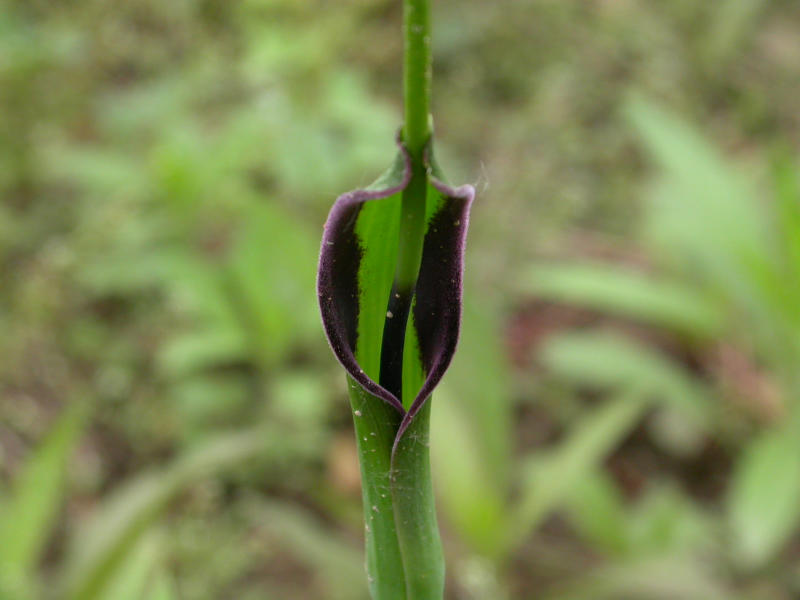
Pinellia ternata is part of the Araceae family of flowering plants that includes more than 4,000 species in over 140 genera. The Araceae family of plants is also known as the Arum family.
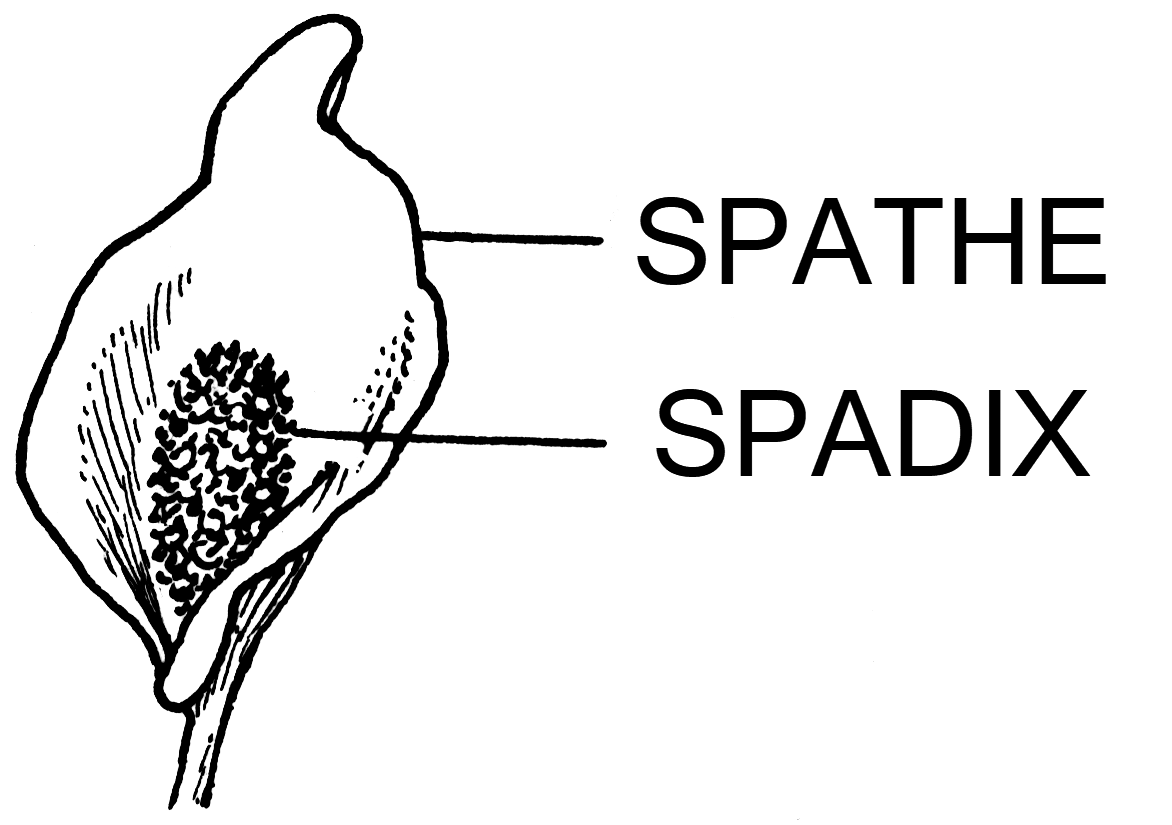
Araceae have flowers on a type of inflorescence called a spadix. The spadix is an arrangement of tiny flowers that cluster around a stem. The spadix is usually accompanied by a spathe. The spathe is a leaf-like bract that grows along with and may enclose the spadix. For many plants in the Araceae family, the spathe can also be large and colorful.
A Few Other Araceaes
In last year’s post, I specifically wrote about Pinellia ternata, its medicinal uses, and its cultural connections. You can read that post here.
This year, I want to look at two other plants that fall within the Araceae family: the Peace Lily (genus Spathiphyllum) and Titan arum (Amorphophallus titanum)
Peace Lily
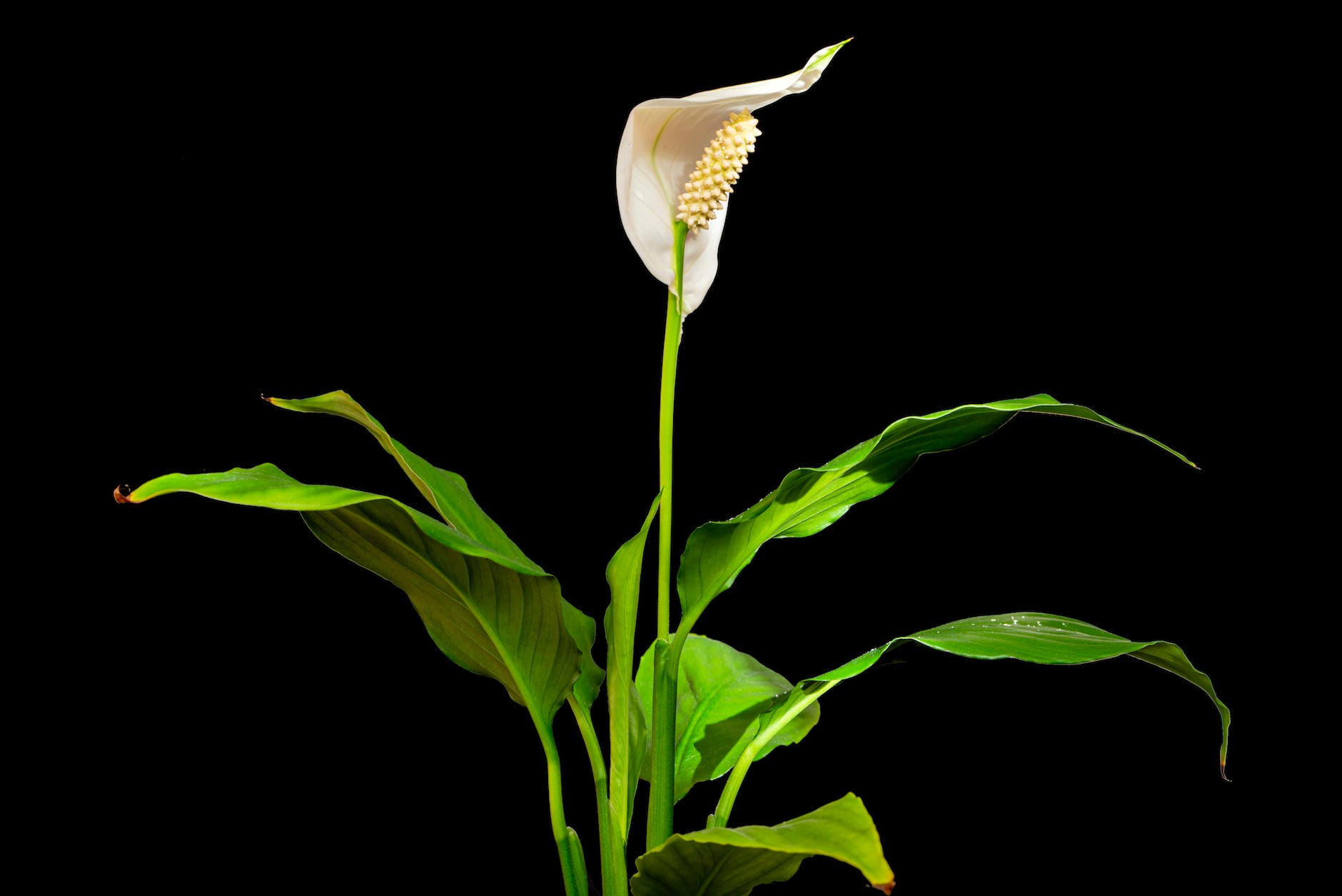
Peace Lily is a term that is used to describe several species of flowering plants in the genus Spathiphyllum. There are about 47 species in the genus Spathiphyllum. These perennial plants are native to tropical regions of the Americas and southeastern Asia.(4) It is important to mention that although the name of this plant is peace lily, it is not a true lily. True lilies are part of the Liliaceae family of plants, whereas peace lilies are Araceae family.
Peace lilies are common house plants in the United States. They are considered pretty easy to take care of because they don’t need large amounts of water or light to survive. They will also let you know when they need water because they will begin to droop.
Peace lilies are also considered great plants to help clean the air in your house. It is said that these plants can neutralize toxic gases such as carbon monoxide and formaldehyde.(5)
A peace lily will usually produce its spadix and spathe in spring. Many peace lilies have white spathes, but some may have tints of yellow or green. A well-cared-for peace lily may bloom again in the fall.
Titan arum (Amorphophallus titanum)
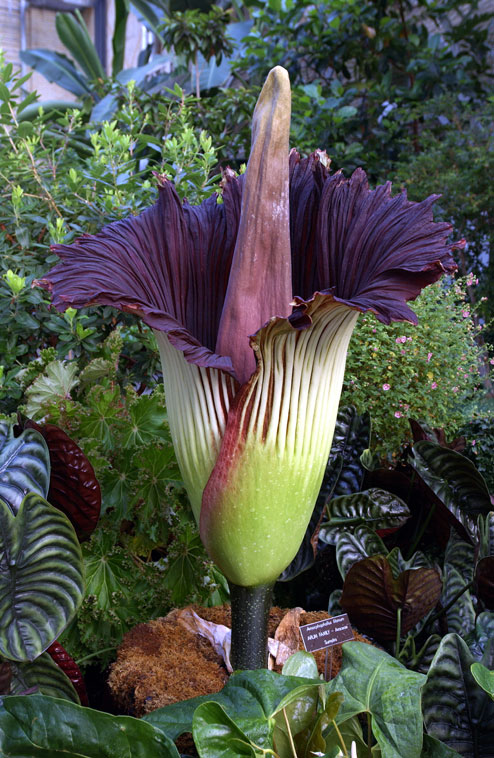
Titan arum, (Amorphophallus titanum), is also called the corpse flower. This plant is native to the rainforest of Sumatra but has found its way to botanical gardens across the globe. This unique plant blooms about every 4 to 10 years (although there have been some exceptions) and creates a flowering spadix that may reach close to 10 feet in height. The spathe, which wraps around the spadix is “green to cream-coloured on the outside with a deep crimson to purple interior.(6)
When the plant blooms it has the ability to generate its own heat and produce a smell of rotting meat. The titan arum uses the combination of smell and heat to attract flesh flies and carrion beetles that help pollinate the plant. The pollinated flowers then produce bright red or orange fruits that are distributed by birds and other animals.
The titan arum has a very short bloom which begins in the afternoon. The flower will stay open all night and the spathe will usually begin to wilt as soon as 12 hours after blooming.
During the titan arum’s dormant years, it produces one leaf and leaf stalk that can be 15-23 feet tall. The leaf stalk “is speckled with white patches and typically features three branches topped with numerous large leaflets.” After 12-18 months the leaf will die back and the plant will become dormant again. It will take several years of this leafing process for the titan arum to store up enough energy to bloom again.
Seasonal Haiku
According to the World Kigo Database the “crow-dipper” is a mid-summer plant. Usually in this section, we would now identify what other plants and flowers are listed as midsummer plants. However, since we focused on flowers last week, I thought that we could use this opportunity to shift things up a bit and explore “midsummer” as a kigo.
Dr. Greve explains that “midsummer” runs from approximately June 06 to July 06 and includes the summer solstice. Charles Trumbull further explains in a section from A Field Guide to North American Haiku titled “Midsummer Madness”, that “‘midsummer’ is not a specific date but rather a season, or more accurately, a part of a season.” The part of the larger season that Trumbull is referring to is, of course, the summer season.
In the 72-season calendar, summer begins on May 5th with the micro-season “The First Frog Calls” in the season of First Summer (May 05-May 20), and then ends on approximately August 6th with the micro-season “Heavy Rain Showers” in the season Major Heat (July 22- Aug 06).
Trumbull then tells us that “Height of Summer” (Seika), “Midsummer days” (manatsubi), and “Summer is deep” (natsu fukashi) are phrases that reference midsummer.
“Short nights”, “Dawn hastens”, “Dawn rushes in”, and opposite phrases like “Long days” are also ways to indicate this time of year. It’s interesting to see how these astronomical and meteorological conditions can also be used as kigo.
Now, with all this information about the midsummer season, let’s read some haiku!
Basho
Even these long days
are not nearly long enough
for the skylarks to sing
(translated Sam Hamill)
washing my feet
I fall asleep for the short night
with my clothes on
(translated by Jane Reichhold)
Shiki
The short night;
Lights remaining
 In the harbour.
(translated by R. H. Blyth)
how much remains
of my life
the nights are short
(translated by Shiki-Kinen Museum English Volunteers)
Buson
Brief night!
Atop the caterpillar
a dewdrop
(translated by Janine Beichman)
Jane Reichhold
even shorter
the summer night
with a full moon
Issa
from the treetop
gliding into midsummer...
bright moon
(translated by David G. Lanoue)
becoming demons
becoming Buddhas...
the midsummer clouds
(translated by David G. Lanoue)
Translator’s commentary, “In this haiku Issa plays the age-old game of looking for familiar shapes in the clouds. The fact that he sees the “opposites” of demons and Buddhas makes for humor, but also, as so often is the case with Issa, hints at a deeper meaning. Demons and Buddhas arise from the same stuff and both are, essentially, illusions: wisps and billows of steam. Issa’s poetic joke turns out to be one of his most penetrating comments on the nature of reality.” (David G. Lanoue)
And perhaps, just one more haiku by Basho
The wandering crow
finds only plum blossoms
where its nest had been
(translated by Sam Hamill)
This haiku is not specifically related to midsummer. It would actually be an early spring haiku because of the “plum blossoms”. I included it this week for a quick reference back, even if very indirectly, to where we started with the crow-dipper.
Haiku Invitation
This week’s haiku invitation is to write a haiku or senryu that references midsummer in some way. Think about the longer days, the shorter nights, or the increased heat.
Share your haiku in the comments below, or post on your own page and link back to this post. I can’t wait to read what you write!
You can support this newsletter work by donating at “Buy Me a Coffee” or shopping at our bookstore.

Thank You!
Resources
- Andy Senesac, “Weed Of Interest: Crowdipper–If You See It, Don’t Let It Go!”: Cornell.edu
- “Pinellia ternata”; Wikipedia
- “Araceae”: Wikipedia
- “Spathiphyllum”; Wikipedia
- “How to Grow and Care for Peace Lily Plants”; HGTV.com
- “titan arum”; Brittanica
- “Season of Summer”; World Kigo Database
- Charles Trumbull; “Midsummer Madness”. A Field Guide to North American Haiku. Retrieved from Frogpond 43_3
 SeasonWords.com
The first haiku by Basho, inexpressible. Someday I have to do an illustration for it!
Hi Phil, That sounds like a good idea! I’ll keep an eye out for it. I hope you have a good weekend!
Thanks Mark, you too!
The two by Issa will have me pondering for days.
Right! The demons and the Buddhas. So good!
Wonderful
thankyou
short night
cools the sheets but still
we sweat
Very relatable. 🙂
Very nice! It’s great to see the use of “short night”. It’s on of those phrases that meets that simple yet suggestive language goal of haiku. Thanks for sharing!
I can just feel the restlessness.
Griffin, you nailed a midsummer night in your haiku. Nicely done.
Reblogged this on Art, Music, Photography, Poetry and Quotations.
Your haiku is rich with sensory summer imagery, Goff!
Thank you Mary Jo for the read and generous comment. Much appreciated. Have a great weekend My Friend.
You’re welcome. Have a lovely weekend, my friend. 🙂
Cheers. Stay Smiling.
Thanks, Mark! Now I know what they’re called. The peace lilies around here are about to flower. I chose birdsong for this midsummer kigo.
Nightingales all night
Wood and forest loud with song
Robins before dawn
Birdsong any time of day is lovely.
Even the caw of a few crows 🙂
Yes! I have noticed that the robins are singing before dawn. What a great observation!
Love this one Mary Jo 🕊️
Thank you! I was trying to convey the short night with how its many sounds can sometimes keep us awake as well as lull us to sleep. We just fall asleep and then the robins wake us early. 🙂
Very nice, Mary Jo. I don’t know that I have heard a nightingale sing, more’s the pity. Robins, yes, but not nightingales.
Haven’t heard a nightingale myself! They’re not indigenous to the U.S., but they are the subject of so much romantic poetry I couldn’t resist. I think haiku, like other creative writing, needing be 100% autobiographical. Not sure of the tradition actually. 🙂
Robins, I’ve heard, but never nightingales. What a shame! ~nan
Haven’t heard a nightingale myself! They’re not indigenous to the U.S., but they are the subject of so much romantic poetry I couldn’t resist. I think haiku, like other creative writing, needn’t be 100% autobiographical. Not sure of the tradition actually. 🙂
I don’t know if they have to be autobiographical, but mine generally are because I am not that clever enough to do the research (although with the search engines like Google, it has become easier). On the other hand, I feel better knowing that nightingales don’t live around here (US). ~nan
Hi Mark. Here is my response to this week’s reference prompt – ‘Midsummer’.
Happy Friday Everyone.
Hi Goff, Wonderful haiku for the season! Thanks for sharing. I hope you have a good weekend!
Mark,
Thanks for the into to the Crow-Dipper, which reminded me very much of some flowers on my dining table… that got incorporated in my offering this week (enjoy); …Other Araceaes…
This is the only pair without a ‘note’;
peace lily
sympathy gifted
on her death
Some requests fall on deaf ears; “No plants please” and yet with grace, taken in.
© JP/dh
Thank you for all your wonderful work, Jules. Plus, you helped me not have to ask about calla lilies! I hadn’t realized until this discussion today that they are misnamed. Though I did always wonder why they were shaped so differently.
I may not have looked up cala lily if I hadn’t been gifted some and they looked similar to Mark’s photo. 🙂
Hi Jules, Thanks for sharing these. The peace lily pair is stunning and I also really like the use of the salsa jar in the calla lily haiku. Excellent!
Thank you – The calla lilies are still doing well 🙂
❤️
Such a poignant pairing, Jules!
midsummer
savoring the days
before the heat
It feels somewhat shameful to share this poem because so many of my friends are in tremendous heat already, but here in Long Beach, June gloom is just about to end. Already the forecast for the weekend is 10 degrees hotter than last week. It always feels like someone snapped their fingers when we go from high 60s to the 80s so quickly . But the 90s are coming and they will last throughout August and September.
Long ago, I lived in Las Vegas for 4 and a half years. I remember going a month over 100 degrees. I was in my 20s. Now, at 56, I just couldn’t handle it as I already feel hot all the time. 😂
Hi Eavonka, I hear you about the heat! I keep talking to my partner how we need to move farther north! It was a humid 78 today and I was not enjoying it. I also really appreciate you awareness that midsummer is not usually the warmest part of the year. Although, this may be up for debate depending on your location. Thanks again for sharing your thoughtful work! I hope you have a good weekend.
Ha! Mark, you don’t have much farther North to go. Canada here you come!
Lovely 💗
Thanks so much!
I’m never ready for the seasons to change until each one has worn out its welcome. The thought of having that kind of heat for long periods is daunting. When heat keeps us indoors during summer, it feels reversed. In the Midwest the cold keeps us inside. Your last sentence is truly funny. 🙂
That’s why I love this place. I get to find out about the seasons from so many different regions (especially of the US). I should note that other people don’t like May grey and June gloom because it’s overcast and cool. They love the heat and the beach. I’m an outlier.
Well, I’m probably one of only a few who prefer May grey and June gloom to beach season. ⛱️
I seem to be an outlier in my love of May grey and June gloom when everyone else is waiting for beach weather. ⛱️
Eavonka,
Love the ‘ku and the story behind it too. It’s been relatively nice here temperature-wise. Here’s hoping you continue with the mild temps.
Well, today will only be 75 so that’s such a treat! Hopefully it won’t be too cloudy tonight as we’re going to a fancy restaurant in the Hollywood hills so we can gaze out at all the fireworks in the city.
Weather is all what one adapts too. I’ve lived in and visited hot places. Our area seems to get warm, but I think only a few real scorchers. Our May was very dry. We’ve had some rain this month – but the corn isn’t nearly as high as it should be.
Thankfully I’m done with feeling hot all the time… But too cold I can do without too. 😉 Keep thinking that now the days are just a tad shorter… maybe that will help? 🙂
Oh, not to worry, we have air conditioning! I live in one of the best weather locations in the nation so truly I have nothing to complain about.
I like where I live. I tell folks I have (mostly) four seasons, three months of each. 😀
mid-summer heat
botanical gardens–
cool bamboo forest
I am really enjoying the contrast of heat/cool and then there is a zooming in quality in this verse. I feel like when I read this, I move from the sun and sky, through the gardens, to sitting amongst the bamboo. So good!
Cool bamboo forest – divine 🙌
Thanks!
This feels refreshing and comforting. We find ways to create refuge and sometimes relish the challenge of switching environments on a whim, or out of necessity! Lovely image.
Having read Mark’s comment, he’s right. All you need is some pandas to eat the bamboo…nan
Hot summer time is my least favorite time of the year, but the botanical garden makes getting out in it worthwhile. And thanks again for these weekly blogs. They are probably the only one I read every week!
Thanks for the kind words and ongoing support. I truly do appreciate it! I hope you have a good weekend.
Thank you for this, Mark, including the reminder about the corpse flower’s rotting meat stench (which I’ve never smelled, only read about). I’ve tried and tried to write a haiku but can’t bring myself to inflict any of them on you. Wishing you a good weekend!
Hi Tracy, I am glad that you enjoyed this post! I also hear you about struggle with a haiku. I have been in a bit of a haiku dry spell lately. With that said, here is bad haiku that I just wrote after reading your comment.
Sunday at mom’s house–
family dinner and stories
of the corpse flower
Lovely setting and so typical of close families. Eating and telling ‘smelly’ stories. 🙂
Thanks Mary Jo! There have been lots of smelly, and sometimes just embarrassing, stories told around the dinner table!
I love that, Mark. What better setting for discussing a corpse flower than the dinner table? Especially if said flower is part of the centerpiece. HA!
A corpse flower centerpiece! Now that would not be enjoyable. And you would need a really big table!
HAHAHA! That’s probably why I flunked Flower Arranging 101.
What a centerpiece that would make, Mark!
I’ve been wanting to say how much I like your haiku, Mark:)
Thanks Madeleine!
We want to read them!❤️🙏🏼
Um, respectfully, you don’t want to read them. 🙂
😂
Great post Mark, I do love lilies of all descriptions ❤️
Thank you for linking up this week! Wonderful haiku that incorporates the longer days and shorter nights.
Thanks Mark ❤️
Delightful. I enjoy visiting your page. 🙂
That’s so nice of you to say ❤️
I like the picture painted by , “a summer night with a full moon.”
Hi Mark. I’ve been hoping to see some stars, but the smoke from Canada has obscured the sky. Here’s my link: https://colleenmchesebro.com/2023/07/01/midsummer-haiku/
Hi Colleen, We have also had many hazy days and nights as a result of the fires. Yesterday afternoon seemed especially bad. Thanks for joining the conversation and sharing your work!
Thanks so much for the opportunity to work on my kigo. It’s always a pleasure. I heard the Canadian wildfire smoke will come and go through the summer until the winter snows put the fires out. Mask up my friend when you have to be out in it. I do.
Hi Mark: I was taken by Basho’s 2 poems, (especially the one where he falls asleep in his day clothes:) I found all the poems delightful to read. I look forward to your blog each week and the information it contains.
I haven’t been feeling well recently and it ‘s been such a comfort and a wonder to read all the posts!
Hi Madeleine, Thank you for your kind words about the blog and I am glad that you are enjoying it. I hope you start to feel better soon.
Thanks Mark. Starting to feel much better!
Hi Mark. This is my first submission.
Hi Ruth, Thanks so much for linking up! What a great offering for this week that highlights midsummer heat!
Thank you so much.
I loved reading about the Peace Lily!
Here are my two:
day wears on…
the sun intensifies
glad I am home
midsummer’s eve long
ago …night blooming jasmine
heaven sent
Hi Madeleine, What a great pair of haiku for the season. The first haiku makes me think of returning home from a long, and somewhat intense, road trip. With the second haiku, I am left wondering what night blooming jasmine smells like. I feel like I might be missing out! Thanks for sharing!
Thank-you Mark! When we were growing up in Florida my mother had planted night blooming jasmine all along the house. I remember it as being very strong, yet quite delightful. I can’t recall the exact scent. Although, I think it might be closest to the Carolina Jasmine:)
Love
“night blooming jasmine”
My daughter’s middle name is Madeleine spelled like yours.☺️
Awwww! I wasn’t sure when I was little…it was a long name to learn to spell, lol, but I am very happy with my name now:)
Gorgeous haiku, especially the night blooming jasmine. I bet the smell is heaven scent! 😉 ~nan
Thank-you very much, Nan:)
Lovely! The comfort and security of home and some beautiful nostalgia.
Thank-you Mary Joe!
Hi Mary Jo: Your poem is wonderful …full of imagery. Delightful to have birds singing through the night. I don’t believe there are any nightingales where we live in California. I do like the distinction you made between the night bird and the morning bird depicting the short night:)
Thank you, Madeleine! 🙂
Thanks for another interesting and informative blog, Mark. I always learn so much from your weekly posts.
midsummer moon
the corpse flower finally
blooms
~Nancy Brady, 2023
midsummer…
the Morse Code
of fireflies
~Nancy Brady, 2017
(modified version published, Stardust Haiku #1, January 2017
midsummer evening
fireflies light up
the grass
~Nancy Brady, 2023
https://nbsmithblog.wordpress.com
Oooh, your midsummer is pretty wonderful! Your poems made me happy.
Hi Nancy, What a great collection for this week. I am really enjoying the “midsummer . . . /the Morse Code” haiku. This is probably because last night I was out on the deck noticing all the fireflies. How timely!
Thanks Mark. I noticed the fireflies for the first time this summer the other night when I was trying to bring the cat inside.There’s something about them that just makes me smile. ~nan
Hi Nancy: it was a pleasure to read your trio…I like that you write about the corpse flower in relation to the midsummer moon …both corpse flower and moon are full of symbolism. I enjoyed your focus on fireflies as well. The morse code of the fire fly is a joy.
Thank you, Madeleine. I’m glad you enjoyed reading them. ~nan
I love how Basho writes about sleeping with his clothes on.❤️
Hi Melissa and Madeleine, I agree! There is something about they way Basho writes that makes it easy to connect with his poetry.
🙂Thanks Mark!
Lol! 😄Yes, Melissa..me too! It’s very endearing…allowing Basho to seem more human:)
Blossoming Sunflowers lower leaves During fast nights
My post will go live in the morning.🌻
Hi Melissa, Thanks for sharing your work! I’ll keep an eye out for your post.
Enjoyed reading your haiku, Melissa!