The micro-season of “Hot Wind Blows” begins on July 07. This is the first micro-season of the season Minor Heat. The other seasons within Minor Heat are:
- Hot Winds Blows (Jul. 7 – Jul. 13)
- The First Lotus Blossoms (Jul 12 – Jul 16)
- The Young Hawk Learns to Fly (Jul 17 – Jul 23)
These seasons were established in 1685 by Japanese astronomer Shibukawa Shunkai. While they are specific to Japan, you can use these seasons as a starting point for your own exploration of the natural world.
To celebrate this season, we will learn about prevailing winds and read haiku by Basho, Issa, Buson, Shiki, and Reichhold.
What Causes Wind?
“Wind” is defined as “a natural movement of air outside.”(1) It can be forceful like a hurricane or gentle like an evening breeze. All winds, no matter their speed and forces, are primarily caused by differences in atmospheric pressures.
The air in our atmosphere typically moves from higher-pressure areas to lower-pressure areas. High and low pressures areas on the Earth are created by the uneven warming of the Earth’s surface. Low-pressure areas are formed when warm air rises, while high-pressure areas are formed when cold air moves in to replace the heated air. While these pressure systems interact to generate various local wind patterns, including sea breezes, land breezes, mountain breezes, and valley breezes. They also interact to create larger global wind patterns.
The Prevailing Winds
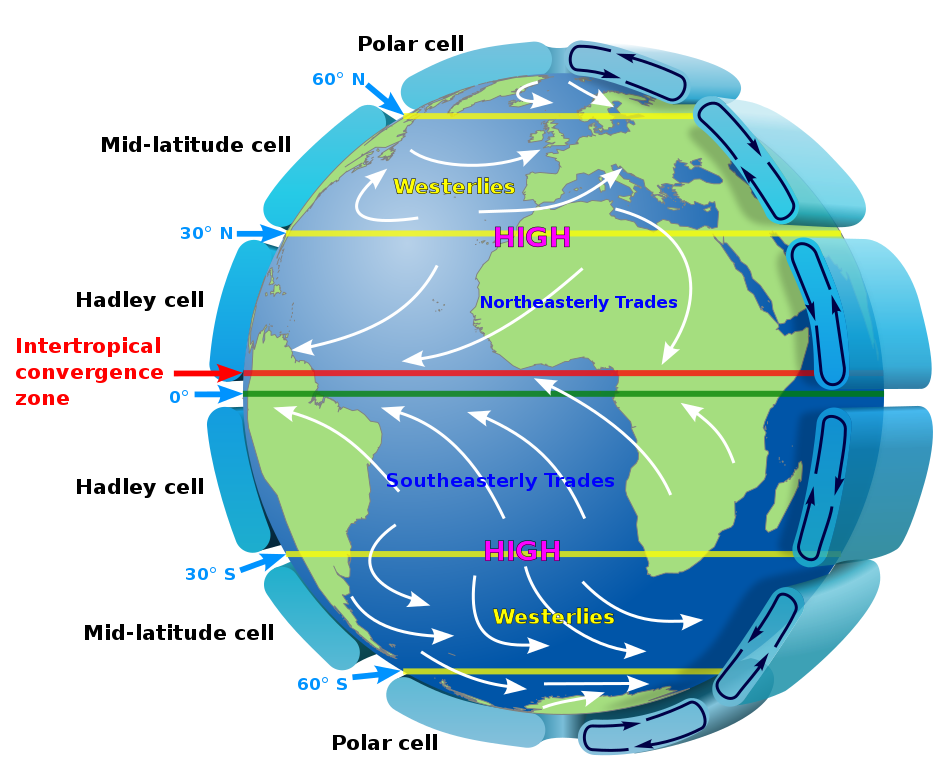
“Prevailing Winds” are consistent winds that occur over large regions of the Earth’s surface and they are divided into five major wind zones. The five wind zones are the Polar easterlies, Westerlies, Horse latitudes, Trade winds, and the Doldrums.
Polar Easterlies
The Polar Easterlies are found around the North and South Poles. These winds are cold and dry and typically blow from the east to the west.
It should be noted that in meteorology, wind is classified by the direction it is coming from. For example, a “western wind” blows from the west to the east. Whereas an “easterly wind” will start in the east and blow toward the west.
Westerlies
Westerlies are prevailing winds that blow from the west at the Earth’s midlatitudes (30-60 degrees latitude). These winds are typically stronger in the winter than they are in the summer.
Horse Latitudes
The horse latitudes are located between the westerlies and the trade winds. The winds in the horse latitudes are usually gentle and can blow in different directions.
Trade Winds
The trade winds are sometimes called easterlies. These winds blow from east to west around the tropics. These winds are fairly predictable and sailing ships have relied on them for hundreds of years Many hurricanes, cyclones, and typhoons start as trade winds.
Doldrums
The doldrums are also called the Intertropical Convergence Zone. This is where the trade winds of the northern and southern hemispheres meet. The doldrums usually produce calm weather and weak winds.
A Few Other Factors
The Earth’s five wind zones are just a part of the Earth’s wind system. Other factors such as the three wind circulation cells (Hadley, Ferrel, and Polar) work in conjunction with the wind zones to slowly move the warmer air from the tropics to the poles, and the Earth’s rotation and the subsequent Coriolis effect further contribute to the global movement of air.
Seasonal Haiku
According to the World Kigo Database, “Wind” is a non-seasonal topic. But there are seasonal wind phenomena.
Examples of seasonal wind phenomena include, “Spring breeze” and “Morning East wind” which are spring kigo. “Summer wind”, “South wind”, and “Scented breeze” are all summer kigo. “Autumn breeze”, and “Autumn wind” are autumn kigo. “Cold wind” and “Dry wind” are Winter kigo.
In The Five Hundred Essential Japanese Season Words as selected by Kenkichi Yamamoto, “South wind” and “Wind in the verdure” are also summer kigo. Verdure is the greenness of growing vegetation.
In A Dictionary of Haiku, Jane Reichhold lists the general terms of “wind” and “breeze” as summer kigo.
Now with all this in mind, let’s read some haiku.
Issa
wind on the greenery--
the weary faces
of people
(translated by David G. Lanoue)
popping up to see my house
in windblown greenery...
the sun
(translated by David G. Lanoue)
wind blows--
lots of rips, my so-called
mosquito net
(translated by David G. Lanoue)
In the haiku above “wind” is a non-seasonal topic and “mosquito” is the summer kigo
Basho
How gratifying it is –
Snow patches fragrant in the summer wind
At Minamidani.
(translated by Earl Miner)
Buson
The evening breezes–
The water splashes against
A blue heron’s shins
(translated by Donald Keene)
In the haiku “blue heron” is the summer kigo.
Shiki
the steam train very quickly
climb the mountain
the wind blow through fresh verdura
(retrieved from Masterpieces of Japanese Culture)
Jane Reichhold
desert winds
blowing mountains
into the sun
wind time
desert clouds blow
light into sunrise
warm wind
children's voices
melt in the night
Haiku Invitation
This week’s haiku invitation is to write a haiku or senryu that references summer winds or summer breezes.
Share your haiku in the comments below, or post on your own page and link back to this post. I can’t wait to read what you write!
You can support this newsletter work by donating at “Buy Me a Coffee” or shopping at our bookstore.

Thank You!
Resources:
Basho’s haiku was retrieved from Matsuo Bashō’s haiku poems in romanized Japanese with English translations. Issa’s haiku was retrieved from David G. Lanoue’s HaikuGuy.com. Buson’s haiku was retrieved from The Classic Tradition of Haiku edited by Faubio Bowers. Jane Reichhold’s haiku were retrieved from A Dictionary of Haiku. Shiki’s haiku was retrieved from Masterpieces of Japanese Culture.


Reblogged this on Art, Music, Photography, Poetry and Quotations.
Thanks Mark for another inspirational post. Here is my response to this week’s writing challenge.
Happy Hurrah It’s Friday Day Everyone.
Mark,
Weather is a fasinating subject – thanks – I learned several new things from this post. Here’s a start (there’s two more at the ‘title’ link);
…hot wind blows…
way too thick
heavy summer winds
barely move
Butter knife employed to cut the air; serve and chew your breath – no picnic.
© JP/dh
It’s so confusing now that it is showing numbers instead of names!
Thankfully, I had the link to your page, Jules. These two (and your others) are a treasure. I love how effectively you capture that stagnant humid heat.
I’ve just checked two different blogs and the numbers are gone…I hadn’t noticed the number [1] took the place of the icon.
I’m glad that is gone. Thanks for stopping by!!
Sometimes the air can be very heavy.
Thank goodness for that, and I’m grateful you let me know. 💜
WP gremlins…
Hi Jules, what a wonderful collection for this season! Thanks for sharing and linking up!
My pleasure 🙂
Here it’s raining heavily 🙂
Thanks for sharing your observation about your location. Heavy rains often accompany warmer weather. We had a few thunder storms
After some warm then hot weather from May through June, we now have cooler temperatures and strong winds.
Butterfly,
Buffeted by the wind;
Holding on.
I love how you captured both the strength of the wind and the fragility of the butterfly, Ashley.
Thank you, Eavonka, I was trying to read in the garden and I spotted the butterfly desperately clinging to the Buddlea shrub. It reminded me of one of those awful rides in a theme park. 🙋♂️
Hi Ashley and Eavonka, I also like the contrast of the gentle butterfly with the buffeted winds. Ashley, I also really like hearing about the origin of this ku. Very interesting!
Exactly. I thought the same thing about Ashley’s ‘ku, but you expressed it well.
Hi Ashley:
The butterfly haiku is a joy to read and inspiring like the butterfly …never to give up. I am very glad you took a video. (I like the sound of the wind.)
Thank you, Madeleine, I’m surprised I was able to keep my phone steady in the wind! 🙋♂️
Nicely done on the haiku, Ashley.
warm winds blow
all the clouds away
kites color the sky
I had started a version of this poem earlier this week, but today’s prompt encouraged me to changed the first line. I feel it much more effectively captures summer time on the beach here. Not that it has to be on a beach, but that’s certainly what I’ve seen most frequently here on windy days. To be honest, it is a bit of a cheat since the ocean breeze is rarely warm. In fact, our warm winds occur in winter and are called the Santa Ana winds.
I like this because it leaves it to the reader to locate it, beach or park. Also, I’m a bit of a birder and especially love raptors and I immediately thought of Red Kites (Milvus milvus) 🦅
Oooh, super cool. I hadn’t known to think of that. I do like to leave my poems open to many interpretations, but sometimes I can’t resist making it very specific.
Hi Ashley and Eavonka, The kites as either paper kites or birds adds a layer to this ku that I hadn’t thought of. I really like that potential.
Thanks Mark. Watch my 1st film, sorry video! 😎
One place at the shore we used to visit had a kite store. Before they opened to the public they had the empolyees practice with the kites – lovely to see all the different ones. 🙂
I’m always amazed by all the different shapes kites can be, and it truly is a magical feeling to get a kite really flying high. As a child, it gave me such a greater connection to the wind.
Hubby gets help getting a kite up and down with a fishing rod and reel. (Or used to anyway).
Hi Eavonka:
I am very glad you wrote about kites…very cheerful, a wonderful past time that the winds bring us:)
Definitely one way to enjoy the winds!
I really like your poem, Eavonka, it’s a joy to read:) I love the action going on and envisioning all the colors!
Thanks so much, Madeleine! It was a fun one to play with.
The haiku works really well, Eavonka. It doesn’t matter if the facts don’t work for your haiku. Had you not said anything, I would have never known. Does anyone fly kites in the winter? Probably.
Regardless or not, I really like this one.
That’s so great to hear, Nan. I always like including a little insights into my poems here, but I definitely hope the poem works without them.
This is a great place to tell the story of the aha moment, or so I have found, Eavonka. I still think your haiku magic works, with or without an explanation. ~Nan
Hehehe, haiku magic. I love it!
Of course, it is magic of the haiku kind, E. Don’t we always want to create magic?
Hi Eavonka, I’ve definitely had a similar experience where I have a ku that I am not 100% satisfied with and then a prompt makes a good fit and forces a change. I really like the idea of them clouds moving out and the colors coming in!
It’s wonderful that what I learn here so easily helps me create better haiku, Mark. I am glad you haven’t tired of this incredible journey.
Not yet! But I am thinking about what is the next step. I was at a haiku event last night and someone there started telling me about biodynamic farming. I had never heard of this but there is potential. It uses the solar and lunar calendars to support agriculture and land stewardship. I need to learn more!
That would be super cool to incorporate into haiku!
The Buson haiku is the best, Mark! Wind is an element we can’t see; only its effects. The words ‘doldrums’ and ‘ennui’ always make me chuckle. What stays still or is boring in nature!?
Cottonwood fluffs down
on juicy grass and clover
Winter in June masque
Photos:
Hi Mary Jo, I like how you pointed out the winds connection to the other elements.
Also, when I originally read your comment and haiku I thought you were talking about the Basho haiku about snow. After reading your haiku, I began to wonder if Basho was actually talking about snow or was it something similar to your piece.
Oh I’m sorry, Mark, I meant Buson’s haiku!
Haha! I see what you mean, since they’re next to each other. 🙂
Hi Mary Jo:
Your haiku is rich, full of imagery and helped me imagine being there. (I feel the light warm breeze:) …made my day!:)
Hi Mark:
I am so inspired by all the information on the wind and their names…Also, I am beginning to realize it isn’t just a modern day phenomenon, Issa points out people were exhausted in those days too! Basho’s snow patches in the summer wind is delightful.
Yes! The heat just makes us exhausted. .I also like Issa’s one about the mosquito net. That one makes me think of every camping trip I ever took. Thanks so much for commenting today!
I really like Issa’s poem too, Mark— the mosquito net…the same experience could be happening so easily today.
Dry hot wind is the kind we have here in Northern California, which we experienced last week. (I wrote a haiku about it the other day:)
Hi Mark: I was charmed by the great outdoors yesterday:)
.
Here are two haiku:
..
outside on the porch morning breeze
…
When you are alone you see more things;
….
hummingbird bobs on the branch summer breeze
Hi Madeleine, What wonderful pieces for the season! I am really connecting with the hummingbird one. I have memories of that exact scene in my yard. So good!
Very relateable. I enjoy being alone. Though I think I am always observant. I don’t always share what I see with who I am with – sometimes I think they just aren’t interested in the same things I am. I enjoy nature.
A few years ago, alone in my backyard I saw a brown bat during the day – I even got a grainy photo – Sometimes you need proof if others are to believe you 🙂
While there are ‘hummers’ in my area I don’t see many. I feed my birdies, but I don’t have a hummer feeder (yet).
Hi Jules:
Enjoyed reading your thoughts about nature! That’s great to have seen a brown bat. It was a good idea to have taken a picture:) …nice to have on hand:). I have only seen bats a couple of times: flitting through the night air where we live. I don’t have a hummingbird feeder either. Lol:)
I think there are some bats that live in the overhang by the creek. Bats are good. We used to see them when our children were younger and still were playing outside at twilight.
Now though I’m in, to keep away from the biting insects. When I’m out I cover up to avoid that issue. 😉
Nice monoku, Madeleine. I can feel the breeze and see the hummingbird. ~Nan
Thanks Nan. I had been searching for words to describe the stillness I was experiencing!:)
Thanks Mark:
I really appreciate that you shared your insight and that you had a similar experience. It’s always a joy for me to see a hummingbird and to be just sitting outside.
Hi Mark, hoping you can open this. A first for me:
Wow! I’m amazed you thought to take a video, and it’s quite spectacular together.
Haha! I’ve not made a video-verse before! 🙋♂️
Hi Ashley, This is so great. Congratulations on your first video-verse! Now we are all going to have to up our game! . . . But seriously, this is really cool. Thanks for thinking about sharing your video.
Thanks, Mark, I hope you didn’t mind me throwing that video into your post.
Fab Ashley – how did she hold on??
True grit! 😊
Love it!
😍
Funny, I’ve never heard of “Horse latitudes” before but the image it presents in my head is amusing. I am well aquainted with the Westerly winds. You can catch the jet stream from Tokyo to Seattle. It changes the flight time by a whole hour when you have the winds at your back.
Hi Melanie, I was also more familiar for the easterly winds, the westerly, and the doldrums. Well, actually I was familiar with doldrums as a reference to places when there was little wind and not necessarily around the equator. I seem to remember it being a general term used in sailing. I hope all is well!
This is really cool!
Hi Sara, Thanks! I am glad that you enjoyed this one. I hope all is going well.
I used your post this week as inspiration for OLWG
Thanks
Nice! I like the idea of building on the prompt and adding layers. Great haiku too!
Lovely post Mark 🌟
Wonderful offerings for this week! Your “summer winds” haiku is excellent. Great job!
Thanks Mark 💕
Another great post, Mark. I’ve always been fond of the word “doldrums” and grinned when I read the haiku mentioning a blue heron’s shins. HA. Here’s my contribution:
it’s that time of year
cloying linden tree scent
each breeze an assault
Tracy,
Excellent haiku describing how sweetly sick (cloying) the linden tree’s scent is. Not only is the scent an assault, but those trees are constantly shedding something, making a mess. At least, that is my opinion of these trees. ~Nan
Hi Nancy, I take it you are not a fan of the Linden tree!
No, I am not impressed with linden trees, Mark. They are the messiest trees, shedding something every couple months. We have one in our tree lawn, but it’s not the only one in the neighborhood. Apparently, some gardening center donated a whole bunch to the city. They probably disliked the messiness of them, too, and wanted to get rid of them. Suffice it to say, I don’t recall ever writing a haiku about them. ~Nan
Hi Tracy, This is a wonderful contribution. I like the idea of the sweet smell of the linden tree an assault on the senses. What a great description! Thanks so much for sharing!
Very interesting information on winds, Mark. I learned so much about the subject.
Here are a couple haiku about summer winds/breezes.
summer breeze…
the to and fro
of birch limbs
~Nancy Brady, 2020
published in Stardust Haiku #42, June 2020
the south wind fills
our jib
–summer outing
~Nancy Brady, 2023
http://www.nbsmithblog.wordpress.com
Hi Nancy, Well done with these! I am really enjoying the imagery of the “to and fro of /birch limbs”. There is so much movement in those words!
Thanks, Mark. The birch limbs really whip in the wind. I’m always surprised that birds can cling onto the branches. ~nan
Very nice, Nan. Both inspire vivid imagery.
Thanks, Tracy, I appreciate the feedback. It’s appreciated; one never really knows whether a haiku ever makes sense to anyone but the writer. ~nan
Hi Nancy, these are wonderful! I assume from the 2nd one that you are a sailor (I am not)? You must have many sailing haikus that would enchant us? I shall have to check your blog. 🌹🙋♂️
Ashley, thanks for the kind comments on my haiku. My husband is the sailor, and I have sailed with him; I even learned about how to sail from him, but I am not a good sailor (like he is). Unfortunately, he had back surgery several years and his surgeon suggested he give up sailing because of all the twisting and turning required, we’ve gotten rid of the boat. I have written a fair of sailing haiku over the years though because as Toad said, “There’s nothing quite like messing around in boat.” ~Nan
Exquisite haiku, Nancy! The minimum of words you used for the sailing poem is perfect. I love the birch limbs haiku too, I see them swaying back and forth in the breeze.
Thank you, Madeleine, for your kind words on both of them. I love watching the birch limbs sway. Robert Frost wrote a poem called BIrches; his poem is lyrical.
Well done Nan!
Thanks, Jules. Appreciate your words.
🙂
I think this might be senryu, I am still getting the hang of the two.🤷🏻♀️
God made summer sun
Warming summer’s breath
Man made air conditioner
Sometimes if I’m not sure what it is, I call it “whatever-u”
Hi Melissa, yes the line between haiku and senryu can sometimes be hard to define. The way that I have often heard the difference is that haiku is more about nature and senryu is more about human nature. But is not really clear. Here is an article that I like that talks about the difference, in case you are interested in reading more. https://akitahaiku.com/what-are-haiku-senryu-and-tanka/