July 28 to Aug 01 is the micro-season of “Damp Earth Humid Heat”. This is the second micro-season of the season of Major Heat. The micro-seasons within Major Heat are:
- The First Paulownia Fruit Ripen (Jul. 22 – Jul. 27)
- Damp Earth Humid Heat (Jul 28 – Aug 01)
- Heavy Rain Showers (Aug 02 – Aug 06)
These seasons were established in 1685 by Japanese astronomer Shibukawa Shunkai. While they are specific to Japan, you can use these seasons as a starting point for your exploration of the natural world.
To celebrate this season, we will learn about humidity and read haiku by Basho, Issa, Kerouac, and Shiki.
Humidity
Humidity refers to the quantity of water vapor in the air. When the air contains a higher amount of water vapor, we describe it as having high humidity. Increased humidity poses a challenge for our bodies to cool down efficiently, as the sweat we produce cannot readily evaporate into the surrounding air.
Measuring Humidity
When scientists talk about humidity, three terms are often mentioned: absolute humidity, relative humidity, and dew point.
Absolute Humidity
Absolute Humidity is the actual amount of water vapor in the air. The higher the amount of water vapor, the higher the absolute humidity. Absolute humidity is measured in grams of water vapor per cubic meter volume of air.
Relative Humidity
Relative Humidity is the amount of water vapor in the air compared to the amount of water vapor that could be in the air, which is dependent on the temperature of the outside air.
To explain this a little further, warm air can hold more water vapor than cold air. So, given the same absolute humidity, the relative humidity would be higher on a cold day and then lower on a warm day. The warm air has more capacity to hold the water.
Relative humidity is measured as a percentage.
Dew Points
The dew point is the temperature at which the water vapor will turn into water droplets. The higher the dew point temperature, the more water vapor in the air. Dew point is often used as a way to indicate how “muggy” it will feel when going outside.
Typically, a dew point in the 50s feels comfortable. When the dew point reaches the 60s, it starts to be uncomfortable. While dewpoints in the 70s are considered quite uncomfortable and very humid.
Although dew point and relative humidity are similar they are not the same thing. The National Weather Service provides this explanation.
“While dewpoint gives one a quick idea of moisture content in the air, relative humidity does not since the humidity is relative to the air temperature. In other words, relative humidity cannot be determined from knowing the dewpoint alone, the actual air temperature must also be known. If the air is totally saturated at a particular level (e.g., the surface), then the dewpoint temperature is the same as the actual air temperature, and the relative humidity is 100 percent.”(2)
Heat Index
The Heat Index, also known as the apparent temperature, “is what the temperature feels like to the human body when relative humidity is combined with the air temperature.”(4) You can calculate the heat index by plugging your local the relative humidity level and the temperature into a complex mathematical formula, by using a heat index calculator, or by referencing the Heat Index chart.
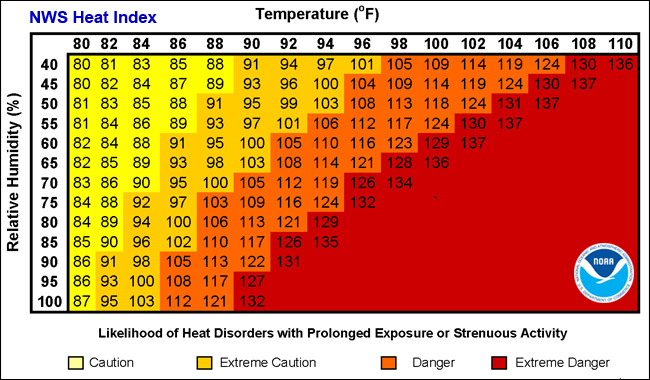
As you can see in the chart, Caution is advised when the heat index is as low as 80°F. When the heat index reaches between 90°F – 103°F, Extreme Caution is recommended and there is a possibility of heat stroke, heat cramps, or heat exhaustion with prolonged exposure or physical activity. 103°F – 124°F is considered the Danger level where heat cramps, heat exhaustion, and heat stroke is possible. 103°F – 124°F is Extreme Danger and heat stroke is highly likely.
Seasonal Haiku
In this season, we are talking about the increased heat of the summer season and its impact. Looking at The Five Hundred Essential Japanese Season Words as selected by Kenkichi Yamamoto, we can see relevant kigo appearing in the Season category and in the Humanity section.
In the Season category, words like “heat”, “smoldering” and “burning” fit with this period. In the Humanity category words like “cooling off” and “swimming” also fit.
In A Dictionary of Haiku by Jane Reichhold, our relevant kigo are found in the Celestial and Livelihood categories. In Celestial, we have “heat”, “heat waves” and “hot days”. In Livelihood, we have “swimming”, “sweat”, and “sleeping outdoors”.
Interestingly, “humidity” is not listed as a kigo in these two sources or in the World Kigo Database.
So now, with all this in mind, let’s read some haiku about hot and humid summer days.
Basho
a lake
the heat misses the clouds
on the peak
(translated by Jane Reichhold)
withered grass—
faint heat waves
one or two inches high
(translated by David Landis Barnhill)
in the cow shed,
the dusky sound of mosquitoes:
lingering summer heat.
(translated by David Landis Barnhill)
pouring the hot day
into the sea–
Mogami River
(translated by Haruo Shirane)
Issa
back gate--
under the big hackberry tree
nobody cooling off
(translated by David G. Lanoue)
back in the house
cooling off again...
moon in the window
(translated by David G. Lanoue)
in heat shimmers
the holy man's
bare feet
(translated by David G. Lanoue)
Kerouac
So humid you can't
    light matches, like
Living in a tank
Too hot to write
   haiku–crickets
and mosquitoes
Shiki
Oppressive heat–
My whirling mind
Listens to the peals of thunder
(retrieved from Terebess Asia Online)
Haiku Invitation
This week’s haiku invitation is to write a haiku or senryu that references the hot and humid days of summer.
Share your haiku in the comments below, or post on your own page and link back to this post. I can’t wait to read what you write!
You can support this newsletter work by donating at “Buy Me a Coffee” or shopping at our bookstore.

Thank You!
Resources:
- “What is Humidity”; Scijinks NOAA
- “Discussion on Humidity”; National Weather Service
- “Humidity”; National Geographic
- “Heat Index”; National Weather Service
Basho’s haiku was retrieved from Matsuo Bashō’s haiku poems in romanized Japanese with English translations. Issa’s haiku was retrieved from David G. Lanoue’s HaikuGuy.com. Jack Kerouac’s haiku were retrieved from Book of Haikus. Shiki’s haiku was retrieved from Terebess Asia Online.
 SeasonWords.com
Blast of cold air
As I enter the market
Hot summer day
Hi James, Wonderful moment that we can probably all relate to. Thanks so much for starting off the conversation this week!
James, this description is perfect!
James,
I was in a store the other day that didn’t have AC on… I didn’t stay long! 🙂
James, you nailed it. That air-conditioning certainly cools the day.
I love Kerouac’s haiku. Thanks for sharing it. Here is one of many summer haiku I have written in the past:
summer in the South:
humidity so high
trees are sagging
LaMon
Hi LaMon, I also really enjoy Kerouac’s haiku. Love the imagery in your haiku for this week. Wonderful!
❤️
Nice one, LaMon. I can so see this (including feeling the humidity).
I remember summers in Japan. It was the rainy season as well as being extremely humid. The haiku says it all – oppressive humidity.
Its even humid in the Northeastern US right now. This season is spot on this year!
Thanks Mark for another great Weekly Prompt post.
Thanks Mark for another great inspirational post and writing challenge. Here is my response to this weeks prompt reference – ‘the hot and humid days of summer’.
Have a great day everyone. Happy Writing.
Hi Goff, Another great haiku that captures the season! Thanks adding to the conversation! Have a good weekend!
Timely! Thanks, Mark. 😎
Thanks! It is hot and humid today!
Climate heat rises
Lakes evaporate each day
The grass cries for rain
Ruth we had about a hours worth of thunderstorm last night. The grass grew, but it is too hot to mow 😉
It is too hot to mow!! Our grass is crunchy and starting to turn. Our gardens are very wilted. We will start watering at least o ce a week.
Ruth,
Our grass is still green, but if I don’t water my veg gardens every day I’m sure they would wilt.
Hi Ruth, I like that you took this prompt as a way to draw attention to the climate crisis. Well done! Thanks for joining the conversation this week!
Thank you!
Great haiku Ruth, sadly so true 💕
Thank you!
Hi Mark:
I really enjoyed all the information about humidity and the heat index is great! Basho’s and Issa’s poems resonate with me! Issa’s poem about the holy man’s feet is wonderful.
Hi Madeleine, I am glad that you enjoyed this post. I agree about Issa’ poem. It is wonderful!
It’s been a delight to read all the poets’ haiku for this week!
Hi Mark: I am reposting as I sent the same poem accidentally to Goff’s website. earlier:
sipping ice drinks
through the day…trying to forget
the unceasing heat
Hi Madeleine, Thanks for reposting your work here also. I like the image of the oppressive heat you haiku conjures up. Well done! Thanks and I hope you have a good weekend.
Madeleine,
Cool drinks are good. I remember though the older folks drinking hot tea to cool off.
It is summer and even after a good thunderstorm, the heavy air seems to return quickly.
Mark,
I had an entry and forgot to hit send… one of those days.
The humidity is frying my little grey cells 😉
Anyway… something new with something old – two more at the title link.
Haiqua; 4 line haiku format; Haiku of four lines (sometimes known as haiqua) or longer have been written, some of them “vertical haiku” with only a word or two per line, mimicking the vertical printed form of Japanese haiku.
acrostic haiqua with Am. Sent
…heat, damp, land…
humidity
effort required
air heavy
trickling sweat
She claims to only perspire; sweat is unladylike, unique to men.
© JP/dh
Hi Jules: I really enjoyed the haiqua you wrote about humidity, along with the very interesting information. It’s great to know that format is available …sometimes you just need that fourth line.
Madeleine,
I know there is another 4 line 17 syllable haiku form. But I can’t find it. Once I had found a whole book with that style, but I didn’t buy it. And now I can’t find any reference to it.
Hi Jules, This is a fun new format! I do think the first pair is my favorite. I hope you have a good weekend.
Mark,
I’m always experimenting with combining forms. The first piece was sort of in honor of my (May she rest) MIL… she always said that she didn’t sweat! I do believe though that there are times I do! Especially when working in humid weather. But I don’t over do it. ~Thanks
when shade
is no help at all
humidity
seasonal
NYC mugging
the heat closes in
My mind went so many ways today that I wrote two. Growing up in a desert area of New Mexico, I knew nothing of humidity until my mom took us to visit relatives in Kansas City, MI the summer I was 11. I was so unprepared for the sensation of not being able to breathe, of finding no respite in the shade, and of all the sweat! 85 degrees there was so much worse than 100 degrees back home where sweat evaporates.
When I went to NYC for grad school, I quickly found out why everyone want to leave the city in the summer!
Hi Eavonka, These two are very creative. The second one about NYC could have a double meaning. It could be weather or crime related. Love it! Thanks for sharing!
Your prompts really bring out my creativity! Thanks so much, Mark.
Way to go, Eavonka. Very creative haiku especially NYC mugging (if you can send it out, do so). Yeah, dry heat…that’s what you grew up with. As for me, we are more like Kansas City.
Thanks for the encouragement, Nan! I am definitely going to submit that poem. I feel for you with the heat and humidity!
Hi Eavonka: These are very delightful poems. I really like your play on words in the second haiku: the word “mugging” as a reference to the humidity of New York City.
Thank you so much, Madeleine! I was pretty jazzed when I figured out how to use it both ways. That’s part of the joy of haiku.
Great prompt Mark 😊 https://poetisatinta.wordpress.com/2023/07/29/micro-season-poetry/
Wonderful haiku! Thanks for adding to the conversation, I hope you have a good rest of your day.
Thanks Mark, I hope you do too 😊
Thank-you Mark for the encouraging feedback:) Hope you are having a good week-end, too!
Thanks, Mark, for all the information and charts about humidity and summer’s heat.
Your posts are always so educational as well as interesting.
A few haiku hot off the press:
hot and humid…
the hazy sky
from Canada’s wildfires
~Nancy Brady, 2023
triple H…
first alert weather prediction
of hazy, hot, and humid
~Nancy Brady, 2023
https://nbsmithblog.wordpress.com
These are great, Nan! If I may be so bold, I think Haiku Girl Summer would love them!
Thanks, E. I just sent her three for July, but August is only a couple days away, and she indicated one submission a month sooooo….maybe I will, thanks!
Hi Nan, The wildfires are a constant this summer. I am always amazed how far the smoke travels.
Thanks for the kind words about the posts. I try to keep them interesting!
Yes Mark, there are way too many wildfires in so many places this year, and the smoke really travels.
Your posts are always so interesting; I often go back and read ones from a year ago. ~Nan
Hi Nan: I really like your haiku, especially the “triple H….hazy hot and humid”! It made me smile.
Thanks, Madeleine.. Appreciate your kind words. I don’t know if the meteorologists ever use the term, Triple H, but I have for several years and thought I’d finally find a use for it in a haiku. Thanks again.
~Nan