February 26 to March 03 is the ninth week of 2024. During this week, we complete the Solar Term of Rain Water (Feb 19 – Mar 04), and have the micro-seasons of “Mist Starts to Linger” (Feb 24 – Feb 28) and “Grass Sprouts, Trees Bud” (Mar 01 – Mar 05).
Hughes, Basho, Buson, Issa, Shiki, and Reichhold wrote the poems selected for this week.
The 24 Solar Terms
The 24 solar terms were created by farmers in ancient China (206 BCE and 24 CE) to help guide their agricultural activities. Each solar term is 15 days long and is based on the climate around the city Xi’an, which was the capital of the Han Dynasty (206 BCE to 220 CE). (1)
Rain Water
Rain Water is the second Solar Term of the year and the second Solar Term of Spring. Yǔ Shuǐ (雨水) is the Chinese name for this season. Yǔ Shuǐ (雨水) is translated to mean the weather is becoming warmer and there will be rain, or snowfall is decreasing and now it will rain.
The 72 Seasons
The 72-season calendar was established in 1685 by Japanese astronomer Shibukawa Shunkai. Each season lasts for about 5 days and offers “a poetic journey through the Japanese year in which the land awakens and blooms with life and activity before returning to slumber.”(4)
The micro-seasons for this week are the micro-seasons of “Mist Starts to Linger” (Feb 24 – Feb 28) and “Grass Sprouts, Trees Bud” (Mar 01 – Mar 05).
About Tree Buds
A “bud” is an undeveloped stem or branch that contains the beginnings of leaves, flowers, or both leaves and flowers. Buds typically form at the end of a stem or at the axil of a leaf. In colder climates, buds may be covered in specialized leaf parts called scales. The scales protect the delicate parts of the buds from harsh winter conditions. (5,6)
Types of Buds
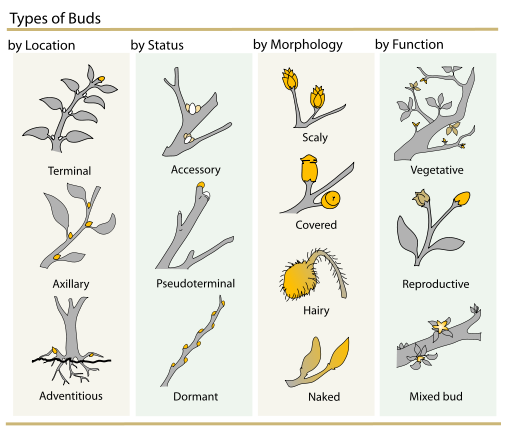
Buds are classified by the location, function, and morphology.
Location:
- Terminal – This bud is located at the tip of a stem or branch.
- Apical – This bud is located at the tip of a stem or a branch but is at the top of the plant.
- Axillary – This type of bud is located in the axil of a leaf. The leaf axil is located between the upper part of the stem and a leaf’s supporting stem.
- Adventitious – An adventitious bud forms in places not identified in the other locations. For example, adventitious buds may form on trunks or roots.
Function:
- Vegetative – A vegetative bud only contains the vegetative pieces of the plant. A leaf bud is a vegetative bud.
- Reproductive – A reproductive bud contains flower parts. This bud may also be called a flower bud.
- Mixed – A mixed bud contains both vegetative and reproductive parts.
Morphology:
- Scaly or Covered – Scaly or covered buds have specialized leaf parts that cover and protect the undeveloped parts.
- Naked – Naked buds do not have scales.;
- Hairy – Hairy buds may be scaly or naked, and they have small hairs that provide extra protection.
Below is an illustration by Mariana Ruiz Villarreal that illustrates these classifications. Villarreal also adds a fourth classification known as “Status”.
Astronomical Season
March 03, the last day of week nine of 2024, is 70 days past the winter solstice and only 16 days away from the spring equinox (March 19, 2024).
Moon Phases
On March 03, the moon reaches its Last Quarter phase. The Last Quarter is about three weeks after the New Moon and about one week after the Full Moon. At this time, the Moon is three-quarters of its way around the Earth and has about 50% illumination.
If you live in the northern hemisphere, the Moon’s left side is illuminated and the right is dark. If you live in the southern hemisphere, the right side is illuminated and the left is dark. The Moon will continue to lose illumination until it reaches the New Moon phase on March 10.
Langston Hughes: “An Earth Song”
Langston Hughes (1901-1967) was a prolific writer who “wrote 16 collections of poetry, 12 novels and short story collections, 11 major plays, eight books for children, seven works of non-fiction, and numerous essays.”(8) Hughes was known for his work that depicted black life in America between the 1920s and 1960s. The following poem, “An Earth Song” was first published in The New Negro: An Interpretation (1925).
“An Earth Song” by Langston Hughes
It's an earth song,—
And I've been waiting long for an earth song.
It's a spring song,—
And I've been waiting long for a spring song.
    Strong as the shoots of a new plant
    Strong as the bursting of new buds
    Strong as the coming of the first child from its mother's womb.
It's an earth song,
A body song,
A spring song,
I have been waiting long for this spring song.
This poem has since been turned into a children’s book illustrated by Tequitia Andrews.
The Kigo
In The Five Hundred Essential Japanese Season Words as selected by Kenkichi Yamamoto, “Tree buds”, “Young Grasses”, and “Sprouting Grasses” are all potential kigo for this week.
In Jane Reichhold’s A Dictionary of Haiku, “Budding Birches” and “New Grasses” are other potential kigo.
Now with all this in mind, let’s read some haiku about the emerging plants
Basho
flower buds
sadly spring winds cannot open
a poem bag
(translated by Jane Reichhold)
In windblown spring rain,
budding, like a straw raincoat,
a river willow
(translated by Sam Hamill)
emaciated
yet somehow the chrysanthemums
begin to bud
(translated by Makoto Ueda)
Issa
twisting, turning
the cat scratches his face...
budding tree
(translated by David G. Lanoue)
every tree
with its calling card...
spring buds
(translated by David G. Lanoue)
in the thicket no one
knows about
trees budding bright
(translated by David G. Lanoue)
Buson
Buds
you bloom without knowledge —
butterbur
(translated by Allan Persinger)
Shiki – (A tanka)
two feet tall,
the crimson-budded roses,
their young thorns
tender in
the soft spring rain
(translated by Janine Beichman)
Reichhold
white and thin
the light of spring
where buds dare
March snow
footprints turning back
into grass
Haiku invitation
This week’s haiku invitation is to write a haiku or senryu referencing emerging plant life.
Share your haiku in the comments below, or post on your page and link back. I can’t wait to read what you write!
You can support this newsletter work by donating at “Buy Me a Coffee” or shopping at our bookstore.

Thank You!
About the Haiku
Basho’s haiku were retrieved from “Matsuo Bashō’s haiku poems in romanized Japanese with English translations” Editor: Gábor Terebess. Issa’s haiku were retrieved from David G. Lanoue’s Haiku Guy. Buson’s haiku was retrieved from Foxfire: the Selected Poems of Yosa Buson, a Translation by Allan Persinger. Shiki’s tanka was retrieved from Janine Beichman’s “Masaoka Shiki: His Life and Works,” at the Haiku Foundation Digital Library. Jane Reichhold’s haiku were retrieved from Dictionary of Haiku.
- “The 24 Solar Terms”; China Educational Tours
- 24 Solar Terms: 6 things you must know about Rain Water. ChinaDaily.com
- 72 Seasons App
- “Japan’s 72 Microseasons”; Nippon.com
- “Bud”; Dictionary.com
- “Bud”; Wikipedia
- “Langston Hughes”; Poets.org
- “An Earth Song”; Langston Hughes. Poets.org

 SeasonWords.com

I really enjoyed all the info in this post.
I’m having issues with my keyboard and copy and pasting…
I hope my link comes through;
I love your poems Jules. Your first haiku and monoku touched my heart. I love that “the grass sachet” is bowed tied and the verses are tied together by the last line, “proud child”. The last line is also a lovely surprise. 🙂
While the first haiku was fiction – I based it on the child who gives Mom the bouquet of Dandelions … I do believe it could happen 🙂
My daughter loves to pick the flowers from “weeds” and give them to me. I never tell her they’re weeds.🥰
Melissa… I’ve always tried to tell my children and grands the names I know of blooming things. Recently I got a free plant ID app for my smart phone 🙂
Jules, this is such a lovely image. I agree and believe it to be true, as well. 🙂
I also enjoyed your post about spring pollen . It is very interesting.
Thanks – I too learn when I look things up. :)0
🙂
Hi Jules, The link works, and great collection! “Grass sachet” is very good. Nice work.
I thought about how children pick dandelion bouquets for ‘Mom’ 🙂
Splendid, Mark 🤗 …
Langston Hughes—spectacular!
I liked Shiki – (A tanka) best this week.
And this post loaded with loads of fun facts. Otsukare sama, 🙇🏽♀️ Mark and team.
Amazing.
Here’s a small “general” contribution to the theme referencing emerging plant life.
calm before budding
like furled sails on a sailboat
buds on branch tips
© selma
Thanks all xoxo
This is a lovely poem, Selma. I love the phrase of “calm before budding”. I had never looked at it that way, so much going on in the process of budding!
Hi Selma,
I am glad that you enjoyed this post and the other poems. It’s a lot of fun for me to go out and find new poems to include.
Wonderful imagery in your poem!
Selma,
Nice visuals there…furled sails and the calm; they go together just waiting for some wind to unfurl those sails (I mean, the buds, that is).
~Nan
Thanks for seeing past the words, dear Nan. That’s what I mean. 👏🏽
Bless you
I love Langston Hughes. I like that you’ve begun including different types of poetry with the haiku.
Hi Melissa, Thanks! I am glad that you are enjoying the addition. Thanks for your support!
brave heads pushing through
beacon green through winter’s chill
sun lingers longer
*
I’m not yet ready
for unceasing march of spring
quickening enters.
These are very lovely, Sunra. I see the emerging happening in your first poem and enjoyed reading your reaction to everything going on, n your second. 🙂
Thank you, Maddy! Appreciate your kind words 🌸
🙂
Hi Sunra, I am really enjoying your first haiku and the line “sun lingers longer”. To me, it highlights the slow shift to longer days. Thanks for sharing!
You’re welcome, Mark! Thanks for your kind words ☺️
Sunra,
I can see this…a deep breath of courage to break through the ground and the chill, yet the sun’s lingering helps. As for the second, it seems like spring takes its time (unceasing march) coming. ~Nan
Thanks Nan! ☺️
Hi Mark and fellow poets: Thank-you for another wonderful post! Like the other poets I love Langston Hughs, as well…and this beautiful poem that’s been turned into a children’s book. I will come back soon to read the poems more thoroughly. 🙂
Here is my offering:
It’s been warmer, it’s been raining, too. A daffodil emerged two days ago in our garden,
in the backyard.
spring dawn
a daffodil
twinkles
Hope you and everyone are having a good day!
Hi Maddy, I am glad that you enjoyed the addition of Langston Hughes work. And your haiku! The joys of spring twinkling in the yard. Hooray!
Thank-you Mark! Your feed back means a lot! 🙂
Maddy ~ Not one daff blooming yet. and we are getting rain most of today. Perhaps as soon as we get some sun?
I also like the mini daffs, I think they are called Paperwhites 🙂
Hi Jules. I hope for sun for you too. It’s been raining here, but I am an unabashed rain lover. There, I said it. (Lol!) (I am enjoying watching it from inside the house and I don’t have to go out in it for any reason.) I should probably go live in Oregon. I must say you know your daffs. Paper whites, I think I know the ones, but I am going to go look them up. When the sun comes, I look forward to your poems about daffodils! 🙂
You are very kind. I know I’ve written about them before. Some are all yellow, some have a diffrent color trumpet. ~I I only know what I look up… 😉
The sun is out and it is about 50F at 9: 30 am/ish 😀 Oh I like a good rain too. After the rain I know just where to look for rainbows!
Awww, this is lovely. Yes, I do remember your lovely haiku about daffodils, a little while ago. I love the yellow but also enjoy the white ones, too. I look forward to viewing the different colored daffodils on my walks, but I want to look them up, as well. (lol!) Wonderful, Jules…I can’t think of anything better to do after rain, than to look for rainbows! 🙂
🌈
🙂 🙂 🙂
Madeleine,
Love it. You must be ahead of us. Our daffodils are sprouting here, but no daffodils, just leaves and stems so far. Hope they twinkle soon here. ~Nan
Hi Nan, thank-you for your lovely words. Lol… your daffodils will be twinkling first thing in the morning…in a wink of an eye:)!
I can’t wait for the trumpets of the daffodils to resound, Maddy. It won’t be long now.
~Nan
🙂
pussytoes
just one warm day
and their buds pop
bare brown stems
wag hazel tails
nut catkins
no leaves in sight, suddenly long catkins on the hazelnut
Love these both, Griffin. Are pussytoes the same as pussy willows? I miss seeing pussy willows; they seem like they’ve disappeared. I remember them fondly from my childhood.
Our birch catkins have come out yet; I wonder how they compare to hazelnut catkins. I guess I will have to Google them. ~Nan
Our local nature trail has a section of Southern River Bluff Community that hasn’t been disturbed in 100 years — big Beech trees with scattered pines and smaller hardwoods like Sourwood and Hornbeam. Teeming with spring ephemerals like Hepatica, Trout Lily, Foam Flower. Pussytoes are in the Aster family; the local species is Solitary Pussytoes, fingernail size flowers that look really cool when you’re about 6 inches away but may never be noticed by many walkers.
I so appreciate this plant inventory and how it accompanies your haiku. I am heading out with my tracking group tomorrow. I don’t think we will see any spring ephemerals yet. We’ll see! I am also not familiar with pussytoes. I’ll have to look them up. Thanks for sharing!
Hi Griffin:
I have to say that “pussytoes” stole my heart. I never knew this plant even existed, until this morning. I have just looked them up. 🙂 And they do look like pussy’s toes. It is such a carefree poem…a delight!
I’m later than usual, but lots of stuff to read and do this morning. Here is my humble offering:
under gray skies
white-blossomed trees abound
prophecy of spring
Peace,
LaMon
Not so humble, LaMon. Very uplifting, predicting spring and the purity of white blossoms. ~Nan
I do agree with Nan, LaMon. And I do love the spiritual undertones and the hope we place in spring. This a very lovely and inspiring poem.
Hi LaMon,
This is great! I like that you chose the word “prophecy” and linked it to the the tree blossoms. Well done!
Hi Mark,
Despite doing really well in plant biology in college, I learned so much from your post today. Thanks so much for all the information on classifying buds as well as the moon phases. I found it illuminating (pun intended) that the different hemispheres see a different side of the moon. Here are some haiku:
the first buds
of our crocus
–snow moon
~Nancy Brady, 2024
crocus leaves poke
through the ground
–worm moon
~Nancy Brady, 2024
removing adventitious buds
from our linden trees
and yet…
they return
~Nancy Brady, 2024
#offthecuffhaiku
This one may need some editing; that’s the problem with #offthecuffhaiku (and I don’t usually write 4-line haiku, but it seemed necessary).
I’ll be back to read everyone’s haiku when I can; right now I have to write my blog about the post. Have a great weekend, my friends.
https://nbsmithblog.wordpress.com
These are lovely Nan. I love that you have 2 different moons from two different months for two different parts of the crocus! 🙂 Such lovely imagery in the first, snow moon is a perfect moon for the crocus bud and I can vividly see the crocus leaf poking out of the ground for “worm moon”. Your third, a four lined poem is beautiful, too. I hope you have a great week-end!:)
Thanks, Madeleine, appreciate your comment about the haiku, especially the last. Today, I noticed that some of our crocuses are blooming. They make me so happy. I actually took a walk around the neighborhood to see if I could see others.
Hi Nan, I appreciate your love for crocuses, it is so lovely that flowers can make us so happy.:) That is wonderful they are blooming! I hope you found others too along your walk:)
These are beautiful!
Thanks, Griffin.
Hi Nan, Wonderful collection for this week, and you figured out how to use adventitious in a haiku! I also really like the crocus and the two moons. Both of these are really good.
Hey Mark. Yes, I felt like you presented it as a challenge, and I couldn’t resist. No matter how often we cut them off, painting the trunk to discourage those buds, they grow back. Thanks for the compliment on the other ku. Nan
Nan…
We’ve had buds on our Silver Maples since the few warm days we had in January! It is so nice to see things blooming again!
I was out yesterday doing some pruning… I even saw Eastern Bluebirds (looking at one of the (four) birdhouses I put up! But the rain today – and well just what I call the regular birdies are at the feeders.
Jules,
I’ve been noticing the buds on the trees getting bigger, too. We’ve had rain all afternoon and it continues this evening.
I was about to let the cat go out last night, opened the door after turning on the porch light, and within a foot of our porch, there were two opossums in the yard. Good sized ones at that. I stared at them and they stared at me. It was a little freaky to see them that up close and personal. Needless to say, the cat didn’t go out, and they waddled away quickly when I summoned Rob to come see. Afterwards, I was mad at myself for not taking a photo of them. Don’t think I’ve ever seen one that close before.
Animals are attracted to different things. It is always tricky to take photos in unexpected encounters.
The wind is blowing bunches of tree buds all over our porch roof and sidewalks.
Speaking of unexpected (and your wind blowing the buds off…) Well, we’ve had snow all day so you might be next, if not later this afternoon, perhaps tomorrow.
Yes, 4 inches of snow for us today and I just got done moving the snow plow pile at the end of the driveway.
Mark… we had a brief snow squal Sunday, and some hail. While it started out freezing this morning it has warmed up!
We only had some snow squals and some hail Sunday… and some really fast wind – got my bird feeders empty within a few hours… not by the birds but by the wind (yesterday)!
Fallen pink flowers / a pale shroud under the trees. / Winter’s fresh-dug grave.
This is a poignant and beautiful poem, Rick.
Thanks so much. I love winter and find it as ephemeral as spring here in the mid-Atlantic, given global warming
🙂
Hi Rick, Thanks for joining this week’s conversation! I agree with Maddy that your poem has impact! Nicely done.
Wow, Rick. That haiku could be read two ways, nice pivot line. It’s a poignant ku, too. ~Nan
the fragility
of one naked bud
first rose
For my birthday, my husband ordered me a new miniature rose bush. I had managed to keep another one alive through many bloomings for almost 2 years when rose rust took it.
I had to replant this new bush which had not done well in the shipping process, but did have 12 buds. Only one of those ended up blooming as the others had to be deadheaded. Much to my amazement and delight, I now have one new bud growing.
Hi Eavonka, I am really enjoying this one. I bet you could share this one and get so many interpretations of its meaning. So good!
Yay! I was so hoping it would allow for different interpretations. And yet, I couldn’t resist telling its story. 😂
That is beautiful, and I can just see that tiny little bud unprotected, Eavonka. I hope this rose bush brings you lots of joy in the years to come.
Thank you so much, Nan. Truthfully, I can only take it one bud at a time because these miniature roses are so tricky. Also, I am not a gardener. 😂
Hi Eavonka, I love your poem, your haibun, which adds to the sense of its fragility. To me this first rose is a celebration! And like you have said before about certain haiku, it can mean so many different things to different people. I think your poem is universal! And it’s beautiful.
So kind of you, Maddy. I didn’t mean this to be a haibun, but this is one of the few places I sometimes share the “why” of the poem. I deeply appreciate that the haiku alone feels universal.
Thanks, Eavonka. 🙂 I found both your haiku and your “why” a joy to read and feel the why adds perfectly to your haiku.
I know what you mean about not explaining haiku. I like them to stand on their own, yet in this case, it works.
I agree, Nan, best to let the ku speak for itself.
My husband was away this week so I suppose I just couldn’t resist writing about his gift.
Awww….that’s sweet!
Hi Eavonka, I agree with Nan, your beautiful haiku does stand on its own. I apologize for being so presumptive, earlier:/. Miniature roses are so lovely and even more special as a gift from your husband.
Oh, dear. Absolutely no need to apologize, Madeleine. I’m just the type of person who, for better or worse, always corrects things. I see it as being honest, but lots of people tell me I should just let things go. 🙃
Lol, thanks Eavonka. I agree, I see it as being honest too! And I have to say that it helps me to see things more clearly, when you correct things. 🙂
Hi Mark. Here is my response to this week’s prompt ’emerging plant life’.
Have a great day. Happy Writing.
Hi Goff, Thanks for adding your poem that is full of spring magic!
Pleasure My Friend. Have a great day. .
I really enjoyed reading about Buds, the Moon and the Sun and your inspiring poems This is an attempt on my part..
beginning of spring,
Energy from the sun
A bud emerges
Welcome and thanks so much for joining the conversation!
I like the haiku! It’s one of those “sketch of life” haiku that Shiki talk about. Very nice.
You nailed it, fatihab….it does seem like the sun’s energy ratchets up in the spring, making buds emerge. Glad you joined Mark’s crew.
~Nan
A poem full of joy for the new season just around the corner. Hope you and all have a great week-end!
Wonderful haiku, Geoff.
Mark, if that is alright, I wanted to add a variation:
spring mist
a daffodil
sparkles
Hi Maddy, I like the change. Mist often adds a reflective, or perhaps sparking, quality to things. Nice edit!
Thanks Mark! 🙂
I agree with Mark. Water droplets (mist) catching some sun definitely causes some sparkly daffodils. ~Nan
🙂
And Aloysius’s fur to break into a rainbow! 😉
Thanks, Nan! 🙂
Aloysius’s fur, this is so lovely, Nan…I became intrigued. I felt sure it was a flowering plant. I had to look it up. I wonder if we have it here in Northern California and have passed by it unknowingly… I learn so much on this post. 🙂
Hi Madeleine,
If I ever get to name a flowering plant, especially if it has white petals, I will call it Aloysius’s Fur in honor of your comment here. You probably don’t know this, but Aloysius is a fictional cat, his fur is white, but when it rains and then the sun shines, it creates a rainbow. Thirteen short stories about him can be found in The Adventures of Aloysius. ~Nan
Awww! Thanks Nan for the update and I appreciate the honor:) In my quest to find the plant I brushed over any reference to a story:). I am looking very forward to reading them…they sound wonderful!
Hi Madeleine,
There is no way that you would have known about my book. It’s only been out for a few months, and it hasn’t even gone up on Amazon or Barnes & Noble yet. I have lived with Aloysius in my head so long that he seems like a real feline…always wanting attention. Whenever I think of sparkles of water, I think of him. My illustrator did a phenomenal job on the cover, in my opinion, and she is only a ninth grader (eighth grader when she drew all the illustrations including the cover).
Nan, I just saw this last post and so excited and happy that you are the author! I am looking very forward to reading it. The illustrations sound beautiful too. 🙂
beckoning green buds
abandoning the past
quivering
A set, latest first:
my much loved wife
in her spring green dress
singing in the kitchen!
2024/03/02 19:07
concentrated life
budding
in breathless potential
2024/03/02 19:06
Rain melting snow
on its way
to being forgotten
2024/03/02 18:59
beckoning green buds
abandoning the past
quivering
2024/03/02 18:51
What a collection! I really like “my much loved wife” and “concentrated life”. They brings different feelings and are both very enjoyable. Thanks for sharing.
Nice set, Baron, and I really like the first one about your wife in her green dress singing…how joyful a haiku (just like spring). And who doesn’t forget snow once it is gone. ~Nan
Hi Baron, I agree with Mark, what a wonderful and touching image of your wife. I also love “Rain melting snow…” Very inspiring poems.
This is great Ben, and the last line was a suprise! 🙂
Thanks, Maddy.
I agree with Maddy. This haiku is a joy to read. Thanks for sharing.
Thank you, Mark – You’re welcome.
Hello Mark,
Thank you for all the great information about the seasons, the moon, and the times. And, the introduction to Langston Hughes is greatly appreciated.
Here is my little bit for this week’s challenge:
Hi Suzette, I love this poem which celebrates spring!
Thank you Mark. Much appreciated..Thank you for your work on hosting this challenge. I appreciate it.
Hi Suzette, I am glad that you enjoyed this week’s post. Thanks for linking up and sharing your work with us. I hope you have a good rest of your week.
Thank you Mark for the opportunity to participate. I enjoy! Have a good rest of the week also. Namaste!
Nan, I wanted to congratulate you on your delectable and delightful haiku being chosen by Marshall on the latest posting of THF’s Renku Session! It adds so much to the renku! 🙂
I just saw this too! I am over the moon about it, Nan. I’ve felt many of your verses merited inclusion so I’m so happy Marshall selected this one. 💜💜💜
Thanks, Eavonka. This verse was one of the simpler verses I’ve written. Frankly, I’d given up thinking that he might choose any of my verses, but I find I get quite a few haiku out of my “rejected” verses because it gets me out of my comfort zone. I was pleased with the verse despite all my typo and autocorrect issues in trying to post it and congratulate Dick (AKA Duck). 🙂
Thanks, Madeleine. I appreciate it. To be honest, I had given up ever having a verse chosen for this renku, and I was totally surprised (and pleased) by his choice. 🙂
I am absolutely delighted for you! 🙂
Nan, I positively agree with Eavonka on your previous posts to the renku, they are wonderful, too!
Maddy,
Thanks for saying that. There are so many good verses submitted and I don’t know how he narrows them down each week. I guess that’s his job as a sabiki though. Nothing I’d ever really want to take on.
🙂
I am also blown away by your children’s book, Nan, “Aloysius’s fur”
(“…to break into a rainbow…”!) I am so very happy for you!