It is June and the natural world is very busy. The landscape has turned a lush green. The apple trees have begun to blossom, and bird song fills the air.
For those of us in the Northern Hemisphere, June holds the final days of astronomical spring (March 20-June 20) and marks the beginning of meteorological summer (June 01 – August 31). For those who observe the 72-season calendar, June brings us a variety of seasons including:
- Time for Wheat (May 31 – June 04)
- The Praying Mantis Hatches (Jun 05 – Jun 09)
- Fireflies Rise from the Rotten Grass (Jun 10 – Jun 15)
- The Plums Turn Yellow (Jun 16 – Jun 20)
- The Common Self-Heal Dries (Jun 21 – Jun 25)
- The Iris Flowers (Jun 26 – Jun 30)
Seasons, Kigo, and Haiku
In writing haiku, the seasons and kigo (or season words) are a key part of the haiku. Jim Kacian explains the origins of this in How to Haiku. In this book, Jim states, “In the classic tradition, it has been considered essential for a poem to include a season word to be a haiku. This tradition arises out of haiku’s historic origins in renga.”
Lee Gurga further expands on the impact of kigo in Haiku: A Poet’s Guide. Gurga writes that the season “is the soul of haiku, as simple as that. One can write fine short poems that do not have a seasonal element, but they will not offer the same gift that seasonal haiku do . . . By relating a single instant of time to the season in which it occurs, the poet can suggest a mood that would otherwise be impossible to create in so short a poem.”
Because haiku are deeply connected to the seasons, we begin each post by acknowledging the seasonal changes.
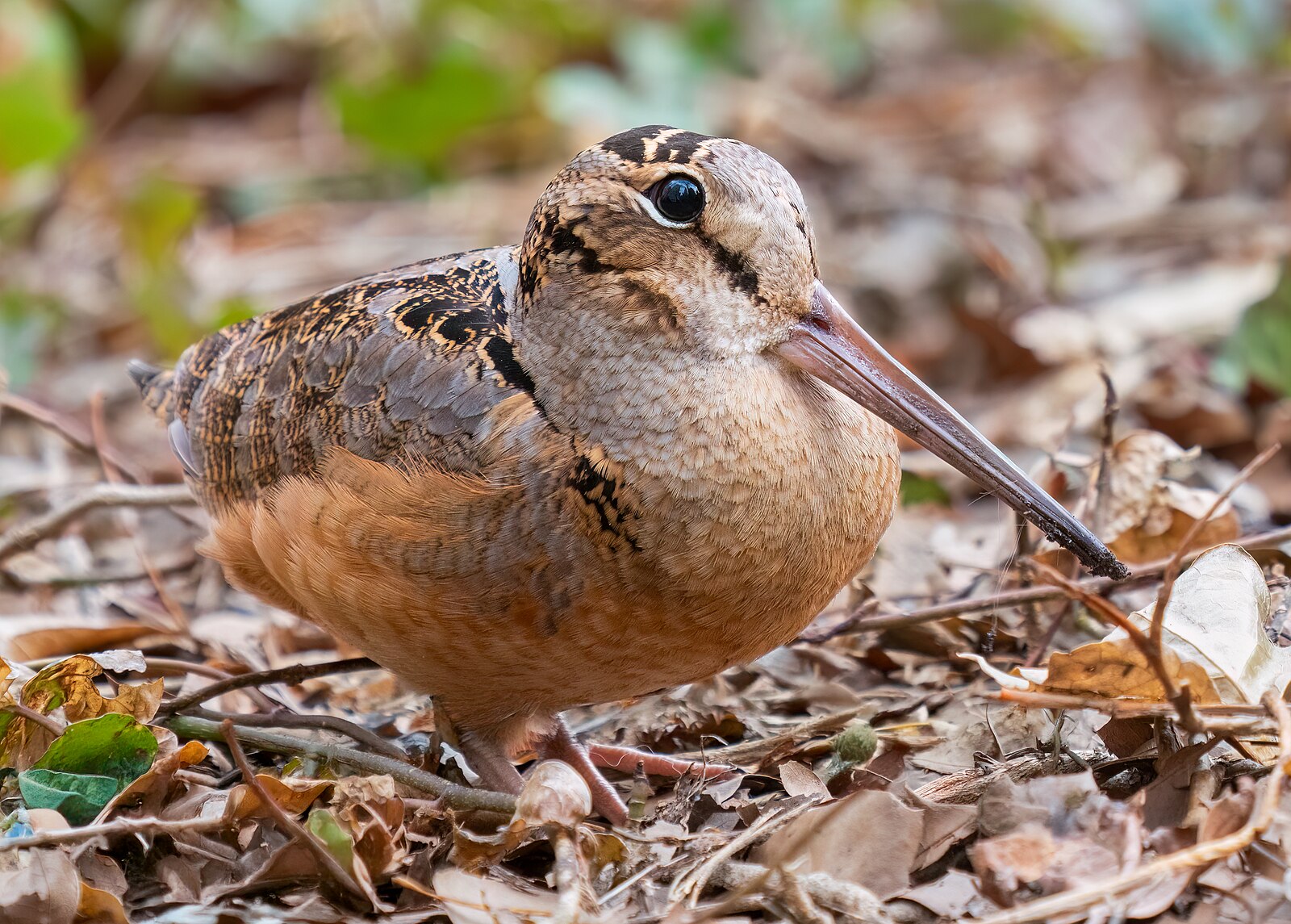
The American Woodcock
A couple of weeks ago, I was sitting on my deck as dusk was settling in. I was listening to the birds and noticing the familiar sounds of crows, chickadees, and blue jays. However, I also noticed that I didn’t hear the sounds of the American Woodcock.
In mid-April to early May, the American Woodcock is very noisy as it engages in its mating behavior. The male American Woodcock has a distinct buzz-like “peent” call that it repeats several times before launching itself 250-300 feet in the air. Once the Woodcock spirals up to its top altitude, it starts zig-zagging back to earth. During its flight, the Woodcocks wings produce a twittering sound as the air rushes through its outer primary feathers. When the Woodcock finally lands back on the earth (hopefully near a female Woodcock), the male Woodcock resumes its “peent” calls before heading back up into the air. This pattern of calls and arial stunts can continue for hours into the night.(2)
So as spring gave way to summer, the bird’s evening chorus also shifted. The Woodcock’s mating call no longer joined the crow, chickadees, and blue jays. This gap in song and this made me think about the way birds show up in our stories and poetry. But more specifically, I began to contemplate how birds show up in haiku and can be used as kigo
Birds as Kigo
In the World Kigo Database, Dr. Gabi Greve explains that while some birds can be kigo, many must be linked to a seasonal behavior or word to become seasonal references.
Crows, for example, require a seasonal reference in order to function as a kigo. Phrases like “baby crow” or “nest of the crow,” make the crow a summer reference. While placing a crow within a seasonal setting, like in “crows in autumn” or “crow in the cold,” makes the crow an autumn or winter reference, respectively.
There are, however, many birds that can be kigo. A few examples are found in The Five Hundred Essential Japanese Season Words as selected by Kenkichi Yamamoto. In this collection, Yanamoto lists “bush warbler”, “skylark”, and “swallow” as spring kigos. While, “old bush warbler”, “kingfisher” and “little cuckoo” are examples of summer kigo.
Further example of birds as season words can be found in Jane Reichhold’s A Dictionary of Haiku. In this reference, Reichhold lists “red-winged blackbirds”, “bluebirds”, “larks” and “robin” as spring season words, and “doves”, “hawks”, and “hummingbirds” are summer season words.
It might be confusing why certain birds are classified as kigo while others are not. The distinction, I believe, lies in the bird’s association with a particular season including their migration or seasonal behaviors.
Birds that are easily found throughout the year typically lack a strong seasonal link and need another seasonal reference. This is why birds like the crow, which can be seen at all times of the year, need another reference to become a kigo. Another way to look at this is that the crow could be the subject of the haiku, and the seasonal reference is separate. (See Basho’s “on a withered branch” and Issa’s “winter wind” haiku below.)
To explore this further, let’s read a few bird haiku from Issa, Basho, and Buson.
Basho
on a withered branch
a crow has settled—
autumn evening
(translated by David Landis Barnhill)
don’t drop your dirt
into my wine cup-
flock of swallows.
(translated by David Landis Barnshill)
a bush warbler
a bamboo shoot in the grove
grieves of old age
(translated by Jane Reichhold)
Issa
winter wind--
he can't find his roost
the evening crow
(translated by David G. Lanoue)
swallows return
on the day eaves are thatched
with irises
(translated by David G. Lanoue)
(Note from the translator David G. Lanoue – The night before the annual Boy’s Festival (fifth day, fifth month), eaves of houses were thatched with grafts of blooming irises)
a bush warbler sounding
a bit more summery...
dewy eaves
(translated by David G. Lanoue)
Buson
As the sun sets
the warbler’s distant voice
also ends
(translated by Allan Persinger)
A swallow cries
as a night-snake strikes
its poor house
(translated by Allan Persinger)
A difficult situation —
a dove’s good manners
and a lonely cuckoo
(translated by Allan Persinger)
A Haiku Invitation
This month I invite you to write a bird haiku. As you write, consider if your chosen bird can be a kigo or if there is a need for another seasonal reference.
Please share your haiku in the comments below, or post on your page and link back. I can’t wait to read what you write!
Formatting Note: To eliminate the spaces between the lines of your haiku when posting in the comment section, hit shift-enter at the end of the line. Example,
one (shift-enter)
line two (shift-enter)
the third line (shift-enter)
About Today’s Post
Basho’s haiku were retrieved from “Matsuo Bashō’s haiku poems in romanized Japanese with English translations” Editor: Gábor Terebess. Issa’s haiku were retrieved from David G. Lanoue’s Haiku Guy. Buson’s haiku was retrieved from Foxfire: the Selected Poems of Yosa Buson, a Translation by Allan Persinger.
References:
- New to Haiku: What is a Kigo?; Haiku Foundation
- “Japan’s 72 Microseasons”; Nippon.com
- “American Woodcock”; All About Birds
- “Crow (karasu)”; World Kigo Database
You can support this newsletter work by donating at “Buy Me a Coffee” or shopping at our bookstore.

Thank You!
 SeasonWords.com
.jpg)
Thanks for this informative post
Thank you! I’m glad you enjoyed it.
Excellent post with info and Haikus on birds!
Thanks for the comment!
Thanks Mark for this post. I have finally looked at Reichhold’s dictionary and will begin using it regularly–a great resource. Thanks, again. I enjoyed Issa’s “a bush warbler”, though I admit the translation of “summery” which may be the clever result of the translator more than Issa–still I liked it! Here is one I wrote this morning, though sitting on my deck only in my imagination.
morning on my deck…
whizzing hummingbirds
fig tree’s sweet smell
Peace, LaMon
Hummingbirds! Yes they are back too, I think they are hungry, they have been buzzing people, coming right up into our faces. I got the message and put out a hanging basket for them.
D,
Just came into the house to make hummingbird nectar, but got waylaid by Mark’s post. We had a male hummingbird show up about a month ago, but haven’t seen him since then. Guess I need to bribe him so better get cracking. Nan
A delightful poem, LaMon. I really like the last line…the food they enjoy. Sounds like a lovely morning.
That is nice, LaMon. Watching hummingbirds zip around is always a treat. I especially love the last line. ~Nan
A lovely poem.
Hi LaMon,
Reichhold’s dictionary is a great resource. There is also a lot of good information on tanka and renga on her main site: https://www.ahapoetry.com/index.html.
Wonderful haiku! I heard my first hummingbird of the season yesterday!
Thanks Mark, I will check out. Peace, LaMon
Is it summer? I did see summer birds, and the first of the robins have fledged, so I guess it is.
goldfinch flits
light at meadow’s edge
glimpse of sun
bright jewels
glimmer in the grass
goldfinches
Wonder if I should switch first and last lines in the second one…
goldfinches
glimmer in the weeds
bright jewels
Hi Avery…Goodmorning. I really like your second version…only because when I read both haiku out loud, the poem with “gold finches” at the top sounds smoother to me. Nevertheless… it’s a great poem and I am sure there are plenty who prefer the original…. Hope you are having a very nice Sunday:)
Thanks! Yes, I prefer that version too.
You’re welcome, Avery😊
I like the switch up of the lines. That makes “glimmer in the weeds” a pivot line so that it can be read two ways. Well done, D.
D, I second what Nan says about your poems. They are definitely “bright jewels.” … Lovely:)
D, two very nice haiku about the goldfinches. They are definitely bright jewels. Nan
Thanks Nan.
These are lovely, I prefer your first version.
Hi DeeDee,
I like also like the rewrite of “bright jewels” because of the pivot line potential of the L2.
It should feel like summer this week! The forecast calls mid 80s by Wednesday.
Good morning, Mark and fellow poets. Wonderful to be greeted with a new Season Words Post…I enjoyed Jim Kacian’s and Lee Gurga’s perspective about seasons and kigo in haiku and your introduction on the American Woodchuck.
I will be back to read all the great poems and hoping to come up with a response haiku or two.
I love using birds as kigo. I’ve got a couple haiku / senryu involving birdson the traila blue egg shell…sunrisesummer bedtime…the birdsstill singchicakadee calland a sudden cravingfor cheeseburgerscounting my stepsto and from the fridge…sandpiper
I love using birds as kigo. I’ve got a couple to share:
on the trail
a blue egg shell…
sunrise
counting my steps
to and from the fridge…
sandpiper
chickadee call
and a sudden craving
for cheeseburgers
glass lake…
seagulls
at a trash can
sunshine
through the trees…
warbler wings
Hi Brittney,
My Apologies that your posts got caught up in the moderation filter. You should be all set to post from now on.
Thanks so much for sharing all these haiku. I really enjoyed “counting my steps”!
These are wonderful Brittney…it’s hard to figure out which one is my favorite. Both haiku, ” Counting steps…” and “chickadee call…” made me chuckle. “On the trail…” and “sunshine…” resonate.) I plan on looking up a chickadee’s call, soon.
Brittney,
What lovely bird haiku! I don’t which one is my favorite. I loved the humor of “glass lake…” but the “blue shell on the trail” is so evocative. All are really good. ~Nan
Lovely post, Mark. Having become enamored with birds of all types, I write a fair amount of bird haiku. Never thought about them as kigo themselves. That’s certainly gives me pause and opens up so many possibilities.
Here are several haiku, which contain birds (either as kigo or not):
crow moon
rose petals drop
onto the casket
~Nancy Brady, published in Stardust Haiku and reprised in Pan Haiku Review 2
penguin love
he presents her
with a shiny pebble
~Nancy Brady, published in Cold Moon Haiku
the trill
of red-winged blackbirds
meadow grasses
~Nancy Brady, published in Haiku Dialogue
faded carvings
in the abandoned cemetery
a crow in the tree
~Nancy Brady, published in World Haiku Review, 2018
I should write something new, but it’s a lazy Sunday. Hope your day is fantastic!
The penguin one made me smile. I liked the visual impact of red rose petals and black crow with the casket. Enjoy your lazy Sunday. Funny, this is me having a lazy day, finally got something penned.
D. thank you. The penguin one was based on watching PBS Nature, and the rose petals one was one I experienced at a graveside service. Crows and cemeteries just go hand in hand. ~Nan
PS. I am soooooo far behind in dealing with emails. I never even wrote a “Pingback” blog about Mark’s post.
As always, loved your haiku. The first and the last were my favorites–something about crows and cemeteries, just seems appropriate. Peace, LaMon
LaMon,
Thank you for kind words on my haiku. Crows seem appropriate in a cemetery. You probably know this already but the collective noun for crows is a murder of crows.
Most of my haiku are “slice of life” and in both of these haiku, they were. I wrote a longer poem about the rose petals on the casket, too.
Stay well,
Nan
Yes, I did know about “murder of crows”. It would be fascinating to know how this collective noun came to be. Would love to see your longer poem sometime. Peace, LaMon
LaMon,
I posted this longer poem on my website several years ago. Here is the link to the post if you are interested. https://nbsmithblog.wordpress.com/2020/04/07/44839-poetry-from-a-zip-code-part-two/
Peace,
Nan
Thanks Nan, it is beautiful!
Peace,
LaMon
Thanks, LaMon. So kind of you.
These are all beautiful haiku, Nan. I wanted to say, “…penguin love…” really resonates.
Thanks, Madeleine. So kind of you to say. You know what they say, “love is love” whether a person or a penguin. 😉 Nan
Madeleine,
Loved you Zen Peacemaker haiku. Did you really make your own eclipse glasses? You are gutsy!
Lol, yes…I guess they do Nan! 😊 Mark, couldn’t have chosen a more perfect prompt for this season:)
Agree with you, Maddy!
🥰 Hope you are having a lovely day, Nan!
You, too, Maddy. It is the season for wonderful days (but then I love summer weather).
Congrats, Madeleine, for having your verse chosen for the Renku Session this week. Unlike previous sessions we can’t even offer congrats on the verse, but I wanted you to know I was impressed. Nan
I love the crow moon haiku, so atmospheric.
Thank you, Joanna. So kind of you to say. ~Nan
Nan,
Ah, I still have the lovely Puffin on my ‘Bird Wall’ in my home 🙂
And you also found a Red-winged Blackbird. I have a cd of bird calls… I need to listen to it. The last time (at a neighbor’s house) I whistled at a Cardinal – it flew away. I used to whistle after I filled the feeders just to let the birds know they had more seed 😉
Jules,
I love puffins, and one day I will see one in the real world, not just in pictures.
I can’t whistle at all (or very little) so I guess I appreciate bird calls because some of them are so complex especially the cardinal’s. That you can whistle and let the birds know food is there, that is great. Nan
Nan – (I haven’t figured out the volume on my new PC… Maybe later.)
Hi Nan,
Great collection! “Penguin Love” seems to be a crowd favorite. I am really enjoying both of your crow haiku. The imagery is wonderful. Thanks for sharing and I hope you had a good lazy Sunday!
Hey Mark,
Thanks! So kind of you to say. I like crows, too…not as much as I like blue jays though. Smart birds they are! ~Nan
Yes, a wonderful season, Nan. We had a couple of summer days, last week. It’s been back to cooler weather though for the past couple of days:) Oh, well.
Nan, I also read your longer poem. It’s beautiful, pulling on my heartstrings. I didn’t mean to cross lines or boundaries… I was greatly moved by your poem and words.
After fluctuating temps (usually in the 50s and 60s, up and down), we are starting to get regular temps in the 70s and 80s. I love the warmth and I hope it continues, Madeleine.
Thank you, Madeleine; that was a lovely thing that you said about it, and you certainly didn’t cross any line or boundary. I posted the link, and my blog is not private. I really appreciate that you took the time to read it. It is one of my favorite (longer, non-haiku) poems I’ve written. So, thank you again. ~Nan
Will keep fingers crossed for you, Nan…I do remember how much you love the warmth…Welcoming Summer and its temperatures over here, too, even though it’s still somewhat cool over here today, lol🥰
Madeleine,
Mostly, I am hoping for no rain on Saturday as my husband and I have an outdoor book sale. A long day especially if it rains.
Just saw your note from yesterday, evening:)
Hope it will be dry weather for you:)
It’s supposed to be rain-free, but then meteorologists are right about 50% of the time. Actually, I think they are doing better, or were…with NOAA’s funding being decreased, weather forecasts may not be quite as helpful. ~Nan
All the same…I hope it was a nice day 🙂
Very sad that NOAA and other Science Programs’ fundings are being cut:/
Me, too, Madeleine. Me, too. We are having so many agencies cut, and the country’s citizens will pay for it in some way or another.
I know…we’ll get through this upheaval somehow, Nan 🙂
I sure hope so, Madeleine.
… I wanted to congratulate you, Nan, for your wonderful haiku posted on the short list of THF’s Haiku Dialogue today:)
Thank you, Maddy. That’s a rarity for me to ever get on the short list. Actually, I thought both of my haiku had been rejected because neither was on the long list that previous week.
Enjoy, my friend. 😎
…the wonderful summer weather that you love:)
Love these Nan. Thanks for posting them. Clive 🙏🕊️
Thanks, Clive. It’s so kind of you to say so. Have a fantastic weekend! Nan
You’re welcome. Have a great weekend yourself
Thank you, dear Nan, it’s very lovely of you to say. I am a fan of your poetry. I always appreciate reading your remarkable haiku. Hope you have a great weekend. 🥰
Aw shucks, Madeleine. I enjoy your haiku, too. Have an enjoyable weekend as well. Nan
🙂
Thanks Nan.
Nan, I wanted to commend you for your poem published on the short list of the Renku Sessions yesterday. It is quite beautiful.
Madeleine,
Thank you. Renku session verses are kind of like throwing spaghetti at a wall to see if it sticks (is done or not). It is hard to tell what the sabicki wants or is pleased with; however, those verses are often good for revising into haiku that later get published elsewhere. That reminds me I haven’t submitted any for this week and I’ve only until midnight tonight.
As for my longer poem, it’s quite a bit different than the haiku, more about the funeral of a friend.
Have a fabulous week, Maddy.
Thanks, Nan, for the feedback…happy that you shared the longer version of your haiku on your website. Hope you are having a lovely Sunday.😊
Hi Nan,
I wanted to congratulate you on your verse being selected for today’s (THF’s) Renku Sessions. It is delightful and fits so well into the Renku.
Maddy
Thanks, Madeleine. I was surprised, to be honest. ~Nan
It’s very uplifting and endearing as well:)
Again, thank you, Madeleine. I had great inspiration from both you and Eavonka since you’ve both had verses in this renku. 🙂
Such a lovely thing to say, Nan. 😊Yes! We inspire each other! I hope you have a wonderful weekend:)!
Awww, thanks Nan. 🙂 Yes, I did make my own eclipse glasses:) I will tell you about it sometime…I am very sorry for missing your post:/
I love your “–jazz hands” haiku in the Haiku Dialogue commentary of Surrealism II–Without Hope–.
Hope you are having a great weekend!
Madeleine,
I’m having a fantastic weekend, spending it preparing for this year’s General election. Re-reading notes from training and working tomorrow on the last day of Early Voting before the election on Tuesday. It’s a long (sometimes difficult) day, but I’ve my Mortal Kombat music queued up already.
I hope your weekend is wonderful, and thanks for the kind words on my haiku. ~Nan
PS. Can’t wait to hear the eclipse glasses story, maybe as a haibun??
Hi Nan,
It’s great to hear from you. I am glad you are having a fantastic weekend. I’m having a lovely weekend, too, staying home and staying warm, lol! (I miss you and all the poets here at Mark’s Season Words:) I am impressed that you’ll be working at the early voting polls today, glad you have your Mortal Kombat music with you!:)… I’ll see what I can do about a haibun!
Cheers,
Madeleine
Wait, what happened to your American Woodcock????
After mating season, the Woodcock becomes fairly quiet. I hardly hear them in during the summer.
D, the penguin haiku comes from watching Nature on PBS. Penguin males find stones to build a nest, and in order to attract a mate. One penguin was lazy and stole the stones that another penguin had gathered. It was pretty humorous especially when he got caught.
I know what you mean about getting something penned. I finally put up a blog about last month’s post from Mark and some publications a day or so ago. Now, I am behind again, alas… Nan
I had a bit of a busy morning and afternoon so I’ve finally arrived with; Agelaius phoeniceus
Here’s the link;
https://julesinflashyfiction.wordpress.com/2025/06/01/nd-6-01-xxv-issho-ni-kaita-retrans/
Agelaius phoeniceus
black oil sunflower
seeds are a red-winged blackbird
favorite all year
Red, yellow, white within the wing is distinctive for this avian.
© JP/dh
Jules, your poem, “…black oil sunflower…” touched a chord. I have learned a little more about the “red-winged black bird.
Years ago a friend birder recomened Black oil sunflower seeds. I also put out smaller feed/seeds mixed with rice for the smaller birds. It is a myth that rice swells up in bird tummies. I try to extend the small seed mix with inexpensive rice. 🙂
Jules, it’s interesting about the black sunflower seed oil…you take good care of the bird life. 😊
Hi Jules,
This poem pair is so enjoyable. It makes me think of all the blackbirds that swarm our feeders in early spring. Its amazing to see how much they can eat, and how much they throw on the ground.
Thanks for sharing and linking up with your page!
I do get some other blackbirds, maybe crackles. But the Red-winged black birds seem to be OK with sharing the feeder.
Stay cool, it has gotten almost too hot alredy. 🙂
Hello Mark and fellow poets,
I agree with Nan, I hadn’t thought of birds, as a kigo, either…I feel like many who do: birds make the world go round…
Here’s what I came up with:
tapping the window
a robin red breast…(its orange!)
full of berry juice
Our niece who is visiting brings a gift from her mom
covered
with a yellow warbler…. and sunflowers
a pink teacup
Issa’s “…swallows return…” resonates with me. I love both swallows and irises:)
Maddy,
Sometimes the colors of birds differ from the descriptions 🙂
The teacup sounds lovely. Hope you are having a wonderful visit. ~Jules
Yeah, it’s fun trying to figure it out…even when there’s discrepancies in markings and colorings…thanks we are:) …it’s been delightful.
Hope you are having a lovely day, Jules. 🥰
Hi Maddy,
Your haiku about the teacup is wonderful! Teacup as L3 was a nice surprise!
I’m glad that you enjoyed Issa’ haiku for this month.
Have a great week,
Thanks Mark,
Really appreciated the great feedback…Have a great week too!
Maddy,
These are both just lovely. The pink teacup haiku has such a neat twist in the third line.
A month and a half later our (mostly volunteer) sunflowers are brightening up the side yard. They have smaller blossoms than I am used to seeing, but multiple blooms on each plant make for a sunny patch of flower bed. Now, I am hoping to see some goldfinches chowing down. ~Nan
Thanks Nan, I appreciate your feedback. The sunflowers sound wonderful…those pesky goldfinches! 🙂
Hi dear Nan, I have loved all your verses chosen for the renku in years past and those on the short list (and present verses in “Cotton Clouds Renku”.) I’ve discovered recently that it is helpful to focus a while on John’s specifications for the next week’s verses. The other thing I find helpful, is letting go and enjoying the process. (But, I am sure you know this, already.) An added bonus to keep in mind is that we have accrued a bunch of verses by the end of the renku 🙂
You have this, Nan
Madeleine
I sometimes forget… (lol)
…Maddy 🙂
proud little yellow chest
at the bathroom window
tap-tap-tapping
twenty three little birds
on the wire near my balcony
watching me, cheeping
in lazy blue skies
hawks circling
hawks swooping
The first two haiku are charming…they resonate, Baron… and I like the juxtaposition of the third poem in L1 “in lazy blue skies…” When hawks begin to do “circling” and “swooping”, I can’t help but start feeling nervous:)
Hi Baron, I agree with Maddy that the imagery of “in lazy blue skies” is wonderful. So much going on there.
I hope all is well and you have a good week!
Baron,
What a variety of birds you’ve captured in your haiku. Without really naming them, I see goldfinches and sparrows in your first two ku respectively, and I am envious of the hawks who ride on thermals. Well done on all. ~Nan
cracked egg
a duck-egg blue
filling with rain
baby crows
finding the cheep
within sunrise
already lighter
the morning song
of a blackbird
Wow, Joanna…these are lovely. “baby crows…” and “already lighter…” resonate with me:)
Thank you so much.
You’re welcome, Joanna.
Hi Joanna, Thanks for sharing these! “already lighter” is definitely my favorite. Well done!
Thank you Mark.
I wanted to congratulate you, Joanna for a wonderful haiku posted on the short list of Haiku Dialogue today!
Thank you so much.
Nicely written images, Joanna. I especially liked the cracked duck egg filling with rain. So, too, are the early morning/sunrise sounds of birds. I love getting up in the early morning just to hear the bird concert. ~Nan
Thank you so much Nan for your thoughtful comments and appreciation of my haiku.
Hi Mark,
Great post thanks. And I love the additional notes about the American Woodcock
Most of my haiku are about birds – many are one-liners – here’s a few …
sunny days tease a blackbirds song
sunshine filling every room the cuckoos call
up on the downs a skylark takes me higher
overnight redwings among the windfalls
the bark of a raven echoing … the silence
among the windfalls a chaffinch nest
I have a ebook out (epub3 format) and an online journal (PDF) of mostly bird related haiku which you may care to have a look at …
https://sites.google.com/view/alwayssparrows/book-cover
Keep up the good work
Clive
Sorry Mark the link above throws up an error. Try this instead …
https://sites.google.com/view/alwayssparrows/download
Nope that doesn’t work either. Works fine everywhere else – so I’m at a loss …
ok one last go …
https://sites.google.com/view/alwayssparrows?usp=sharing
I’ll have to try this link from my phone. My laptop is blocking the Google sites for some reason.
Hi Clive: I agree with Mark. These are great. I really like “spring thaw…” and “coot skitter…”. Glad you posted.
Clive,
What a gift! I just clicked on the link and just started reading about your haiku journey. I haven’t read it all, but will return to it. Thank you for sharing it with Mark (and by extension, all of us). ~Nan
Thanks Nan for liking my haiku and my book. I hope you get the chance to finish reading it. I follow your blog too. Mark has a great site here 🙏😀🕊️ Clive
Hi Clive,
You are absolutely right…Mark’s site is wonderful. I learn so much from each of his posts as well as love the gathering and friendships of other haiku poets.
Thanks, too, for following my blog. I’ve noticed that you often check out my site as well.
I’ll return to your book soon. I encourage everyone here to check out his haiku book using his link as well. ~Nan
Thats great thanks. If you can, download the epub version – it has embedded music, birdsong and videos – makes for a seamless read. Clive
Thanks, Clive. I’ll have to do that.
I should perhaps have mentioned that you will need an advanced epub3 reader such as Apple Books or Adobe Digital Editions for the iPad iPhone or Mac, or Reasily if you have an Android device or Chromebook. Unfortunately it does not work reliably on Windows devices and can’t be uploaded to the Kindle or other dedicated ebook readers. Sorry! The technology will catch up one day. Have a great weekend. Clive
Clive,
I’ve dealt with epub books before. I will figure out something, but thanks for the warning. Looking forward to reading your haiku.
The epub3 reader apps mentioned are all free to download too!
Hi Clive,
These are great! “up on the downs” is my favorite. I like the movement that this one has. It’s a little like a rollercoaster!
Thanks so much for sharing! I hope you have a good week.
Thanks Mar one of my favourites too … I do write haiku over three lines – here’s a few one for each season …
empty feeders
a frosty glint in
the robin’s eye
spring thaw …
through the waterfall
a dipper’s nest
coot skitter
among lily pads
summer rain
all hallows’ eve
blackbirds seeing ghosts
in every bush
Hi Clive,
Nice monoku on all the different birds. I don’t write monoku very well and am always impressed by those who do (like you). You must have different birds than I do. Chaffinch, skylark to name just a few. Even if we have ravens, I don’t know that I have seen them, other than seeing them at the White Tower in London. We definitely have sparrows though, all kinds of different species although as quickly as they flit in and out, I rarely can differentiate between a song sparrow, a house sparrow, etc. ~Nan
Thanks Nan. Greatly appreciated 🙏🕊️
Great one-liners Clive, I love watching the birds.
sunny days tease a blackbirds song
I especially like the one above.
Thanks Joanna, one of my favourites too. Inspired by rereading Richard Jefferies.
Hi Joanna, one of my favourites too. Inspired by re-reading the essays of Richard Jefferies.
Thanks Joanna a favourite of mine too. Inspired by passages from the writing of Richard Jefferies. 🙏🕊️
Thank you, Mark, for the excellent information on references to birds in haiku. I learned something new… I did not know that some birds referenced in a haiku also require a seasonal setting to function as kigo!
I love the haikus you highlighted. The following is one of my absolute favorites of Bashō’s work:
‘don’t drop your dirt
into my wine cup-
flock of swallows’
Thank you, Mark, for your research and insights into writing haiku. Much appreciated. I always learn something new from your posts. Cheers.
Hi Suzette,
Thanks so much for the comment! I’m glad that you enjoyed the selected haiku. The Basho swallow haiku is one of my favorite too. I have used it more than once on this blog.
Thanks again and I hope you have a great week.
You are most welcome, Mark. Blessings and peace to you!
Hi Mark,
Sorry not really with it today. I included links to my book in a recent comment on your latest post. I realise that this breaches etiquette and would appreciate it very much if you could edit my comment and replies removing the offending links. Sorry for the error and inconvenience.
Hope you enjoyed the haiku though.
Best
Clive
Hi Clive,
I think its fine to share a link to your book! If you are okay with having it listed here, I am happy to have it posted.
Thanks Mark greatly appreciated 🙏😀
Hi Mark,
Love the selection of poems. I don’t remember reading “Basho’s “swallows” poem earlier. Thanks for sharing that. I had this one published in Failed Haiku’s August 2024 issue
just the way it is
a robin on the fence
gives a shit
Here is a new one with a bird
freshly cut lawn
a greedy robin looks
for more worms
Biswajit
I like the one about the robins Biswajit, lovely.
Thank you Joanna. I like your poem too.
Hi Biswajit: I agree with Joanna. I like the one about the robin and the surprise in the third line and play on words. 😊 I couldn’t help chuckle!
thank you very much.
Hi Biswajit,
Thanks for sharing your haiku and making me smile at the antics of the robin(s). A bird has to do what it has to do-do! ~Nan
thank you very much Nan
Hi Mark,
Love the selection of poems. I don’t remember reading “Basho’s “swallows” poem earlier. Thanks for sharing that. I had this one published in Failed Haiku’s August 2024 issue
just the way it is
a robin on the fence
gives a shit
Here is a new one with a bird
freshly cut lawn
a greedy robin looks
for more worms
Biswajit
https://benjamintonkin.wordpress.com/2025/06/10/10-6-25-haiku-feat-birds-of-a-feather/
A nice flock of haiku about birds, Ben. Enjoyed them all, but now I have the kookaburra round in my head as an earworm. ~Nan
Great poems, Ben. I especially like “kookaburras laugh..” and also your fourth, “light chills…”. 🙂
Hi Mark – a bit late I know, but I have found your site again, I meant to just take a couple of months break – turned out to be 18! 😄
Here is one for you https://poetisatinta.wordpress.com/2025/07/05/birds-seasonal-haiku/
Welcome back, Ange! You have been missed!:)
I enjoyed your haiku, as well!
Thanks Maddy that is so kind of you to say 💞
😊
For whatever reason, I couldn’t see your haiku when I clicked the link. I read about the swifts though. Regardless, I bet it was spectacular. ~Nan
Hi Nan – sorry that’s my fault I embedded the poem in the image which may be difficult to see, this is it:
evening hush descends
swifts spiral in fading light
day’s last breath aloft
❤️
AJ,
Glad you posted it here. It is quite nice. I’ll check back and look for it again. Thanks.
PS. Now, I understand why I couldn’t read it. For whatever reason, the picture only downloaded about an inch and then there was a blank area the first time I clicked your link. Thanks again. ~Nan
You are welcom
vulture of ares
eats the dead and brings the night
harmonium lives
feathers of vultures
a permit needed to keep
shed the self again
A great, tanka, Rebeca.
Happy Autumn Everyone! Have a spooky and safe evening! 🙂